

Ninety-two million tons—mountains of waste per year! That’s the staggering impact of fast fashion on our planet. In the United States alone, this translates to approximately 81 pounds of discarded clothing per person annually. Many garments are worn fewer than seven times before being thrown away into landfills. Less than 10% of clothing is repurposed or reused, in contrast the fashion industry is responsible for approximately 10% of global carbon emissions.

Slow down. Pause. Let these numbers sink in. And, remember them the next time you look in your closet or feel the impulse to buy a new t-shirt. Consider this: it takes about 2,700 liters of water to produce a single cotton T-shirt—equivalent to the amount of daily drinking water one person consumes over 2.5 years.
Did you know that the fashion industry is moving fast, it now produces twice the volume of clothing than it did in 2000? What role does fashion play in today’s sociocultural and environmental landscape?
Make no misunderstanding, the fashion industry is all about trends. And if sustainability can be branded and sold, they will do just that. And, this is precisely what is happening, call it eco-fashion, or otherwise greenwashing. In her New York Times piece, Fashion’s Latest Trend: Eco Bragging Rights, Venessa Friedman explores how the runways are ‘working it’ by capitalizing on this shift. Gabriela Hearst held a carbon-neutral fashion show in New York. At Milan Fashion Week, Missoni collaborated with eco-conscious artist Olafur Eliasson who made kitschy little solar powered sun lights that the models held while parading down the runway—novelties that the lucky ones in attendance were gifted in their goodie bags. Marketed as tokens with purpose, with proceeds intended toward lighting the off-grid communities of Ethiopia, Senegal, and Zimbabwe, these sun lights were likely tossed aside as novelties, at best.
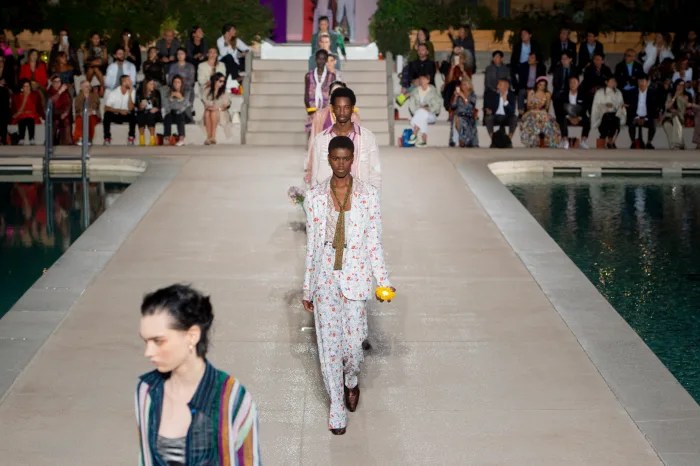
This kind of branded and marketed “eco-consciousness” is meant to make us feel better about supporting fashion consumerism. Glossy marketing and trendy packaging cannot obscure the deeper issues of waste, exploitation, and environmental degradation that are embedded in business as usual in the fashion industry.
This curatorial essay introduces artists whose work–either explicitly or conceptually—examines the textile, garment, and fashion industries’ impact on the environment. Rather than providing a comprehensive critical analysis of fast fashion in the twenty first century and its effects on material waste, energy use, and labor exploitation, I bring together works by artists who invite us through metaphor, irony, poetic sensibility, and materials to reflect on our own participation in these systems of fashion capitalism.
Art as Witness, Art as Catalyst
Can art raise consumer consciousness?
Many artists turn to reusable materials—not only for their accessibility and affordability but for their symbolic resonance. The discarded things serve as metaphors reflecting the increasing impact to human excess, consumption, and disregard for the afterlife of objects. Through transformation these artists offer alternate visions: critiques on the dire consequences of humanity’s overconsumption while some show glimpses of circularity, by way of renewal and reuse.
Michelangelo Pistoletto’s Venus of the Rags was one of the first artworks that made me reconsider my own complicity in fashion consumption. Created over 20 years ago, the work became emblematic of the Arte Povre movement through its use of discarded paint rags. Over time, the work took on a new resonance, embodying the issue of throwaway culture, particularly in the fashion industry. Pistoletto later, embracing this shift, founded Fashion B.E.S.T. (Better Ethical Sustainability Think-tank), an incubator for exploring and implementing ideas on sustainability and social responsibility in the fashion industry.
Since Marcel Duchamp, artists have found inspiration in the ready-made—objects whose archaeological qualities trace the path of the human footprint, offering insights into cultural and historical relevance. By repurposing discarded materials, these artists ask us to consider the symbolic and future life of objects, and by extension, the future of our planet.
Shinique Smith began her career creating bales—totem-like, often over-head-high, towering sculptures constructed with discarded clothing. The term “bales” refers to the tightly bound bundles of secondhand ‘donated’ clothing that is transported from wealthy to poorer nations, moving from a state of excess to one of perceived need. Smith collects materials from everywhere, because, quite simply, unwanted clothing is everywhere.

In Bale Variant No.0026 ( Solar Flares) 2022, Smith layers narratives of labor and exploitation in oppressive working conditions, tracing a dark lineage from America’s history of slavery to the present-day conditions of global sweatshops. As she sorts, stacks, ties, and cinches up her composition, she remains attuned to the stories—both historical and contemporary—embedded in each t-shirt and pair of jeans.
Smith’s sculptural bales reflect our choices: how we adorn ourselves, what we choose to keep, and what we throw away. To the viewer both visually and conceptually, the bales represent the overwhelming mounds of clothing we accumulate over a lifetime, becoming metaphor for accumulation and loss—personal and collective, human and environmental.
At LACMA, Smith extended her practice into a collaborative project with students, creating a sculpture made from socks—an everyday item often overlooked. These humble pieces of clothing, usually tossed for having a hole or missing a match due to the mystery of only one surviving a tumble in the washing machine, became building blocks for meaningful reflection and creativity, transforming the mundane into something beautiful.
Celia Pym, a London-based textile artist, embraces the act of mending as both an artistic practice and a gesture of care. “It’s a small act of care to mend a hole in your sock,” she says. Her art sits at the intersection of craft and fine art. Like Shinique Smith, Pym collaborated with creative primary school students, creating an installation using 488 socks, each one mended with colorful yarn.

Her practice bears similarities to sashiko, a Japanese form of decorative reinforcement stitching, and resonates with wabi-sabi a Japanese philosophy that finds beauty in imperfection and transformation. Rather than concealing damage, Pym highlights it—her bold and colorful repairs draw attention to the wear, celebrating it.
In many ways, Pym ‘s artwork resembles performance art. She invites people to bring their tattered and worn garments—gloves, coats, jeans, and of course, socks—to the art gallery (or community centers.) In a manner of participatory performance, Pym meets with individuals to discuss the personal stories and memories attached to their worn garments. Together, they select which of the brightly colored yarns to use for the repair. She then mends the piece, and later exhibits them alongside photographs of the before and after of the item. After the exhibition, the photographs remain with her, but the garments are always returned to their owners—restored, honored, and transformed.

She never intended mending as an artistic career, at Harvard she concentrated on welding and metal sculpture, yet something shifted as she found knitting—and specifically mending—as a powerful means of documenting life’s journeys and transformations. With each stitch, she affirms the value of the worn and loved garment, offering a quiet but pointed opposition to the habits of disposability and overconsumption.
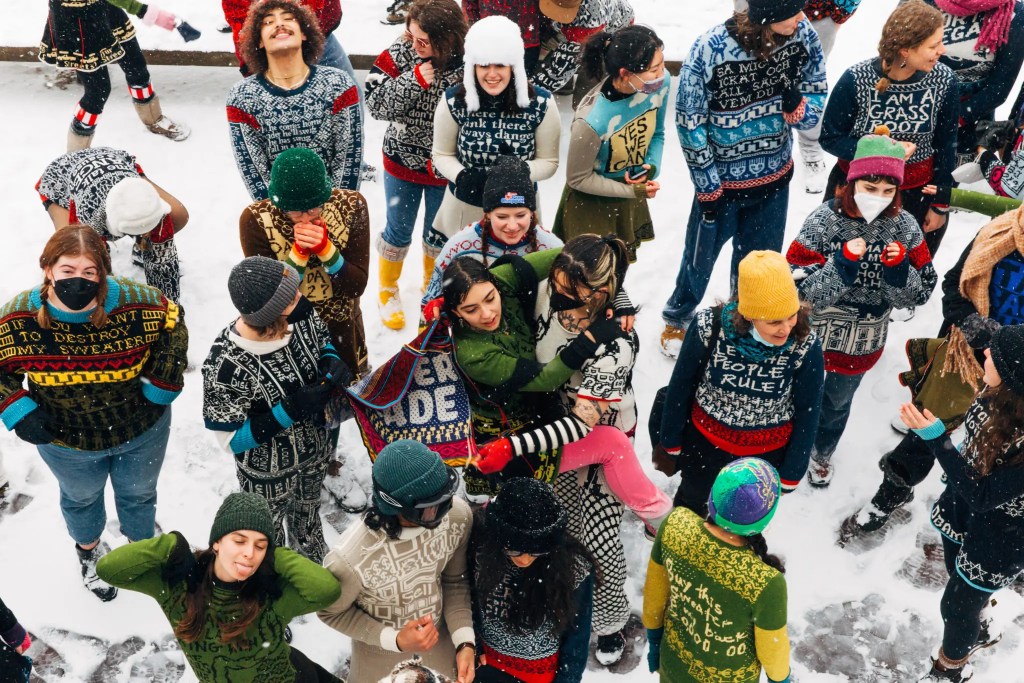
Lisa Anne Auerbach also found her artistic expression through knitting, transitioning in art school from a focus on photography to textile-based works that convey political and environmental commentary. Her sweaters are emblazoned with witty slogans, quotes, catchphrases, and activist messages.

Whereas her art—created by hand or machine—does not explicitly critique fast fashion, it makes a bold statement that our style and what we choose to wear reflects our personality and, in many cases, our values. By choosing to reuse and repurpose we rebuke mass production and consumption, hallmarks of capitalist culture.
Andrea Zittel uses her life—home, clothing, and daily routines—as a platform for minimalist, anti-capitalist experimentation. In fact, her artistic practice emerges from a deep inquiry and exploration to understand norms, values, and psychologies attached to objects. One of her most notable projects, A-Z Uniforms Project, began in 1991 with a simple idea: to design a single handmade, utilitarian, outfit to wear every day for three months, rotating seasonally. Initially made from rectangles and a single thread, the garments are as simplistically beautiful as they are conceptually potent, challenging our association of personal liberty apart from a market-driven fashion industry.

Over time, the Uniforms Project evolved into participatory experiences. Exhibition visitors could borrow, wear, and live in her designs—intersecting the line between viewer and artwork, art and life. “I’ve always wanted my work to travel out into the world,” Zittel explains, “and for people to have the opportunity to engage directly with it, in a way that’s not confined to the awkwardness of the exhibition space.” What began as a personal experiment, a single uniform, became an ongoing investigation into alternative modes of social and cultural participation.
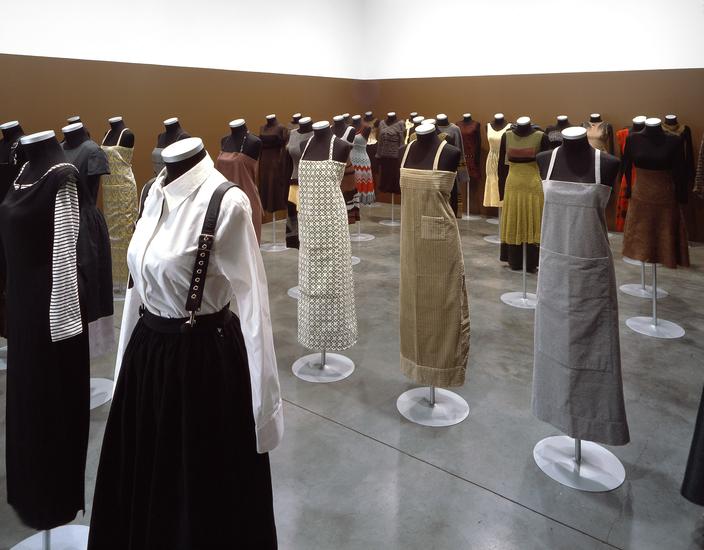
This concept echoes alternative business models that address fashion consumerism, such as Rent the Runway, where people rent instead of purchase clothing. In Zittel’s case, the aim is less commercial and more about reimagining fashion as functional, sustainable, and even participatory.
Experimenting with and creating hand-sewn clothing as sculptural objects, as forms of activism, has been an art practice for decades. In the early to mid-1960s, Mimi Smith utilized clothing as both content and form, that addressed feminism and environmental issues. Her art is simultaneously personal and autobiographical while also serving as a social and cultural critique.

Recycle Coat, 1965 (recreated 1993) made from plastic packaging materials from napkin and toilet paper wrappers, evokes associations with frivolous and conspicuous waste in cheap, ever-changing fashion. It also reflects the woman’s role in everyday shopping for and duties of cleaning and maintaining the home.
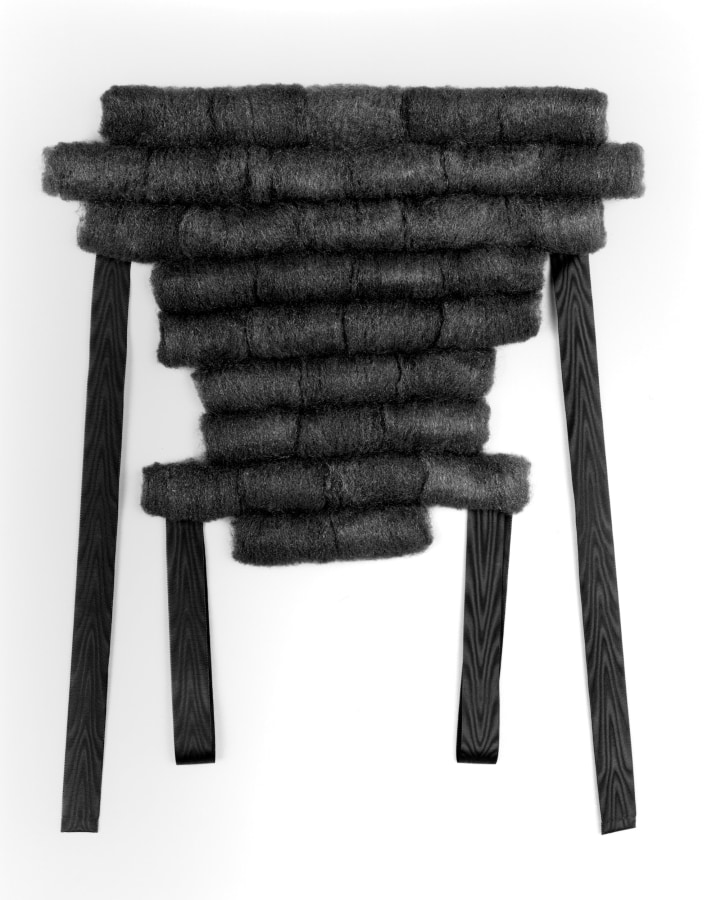
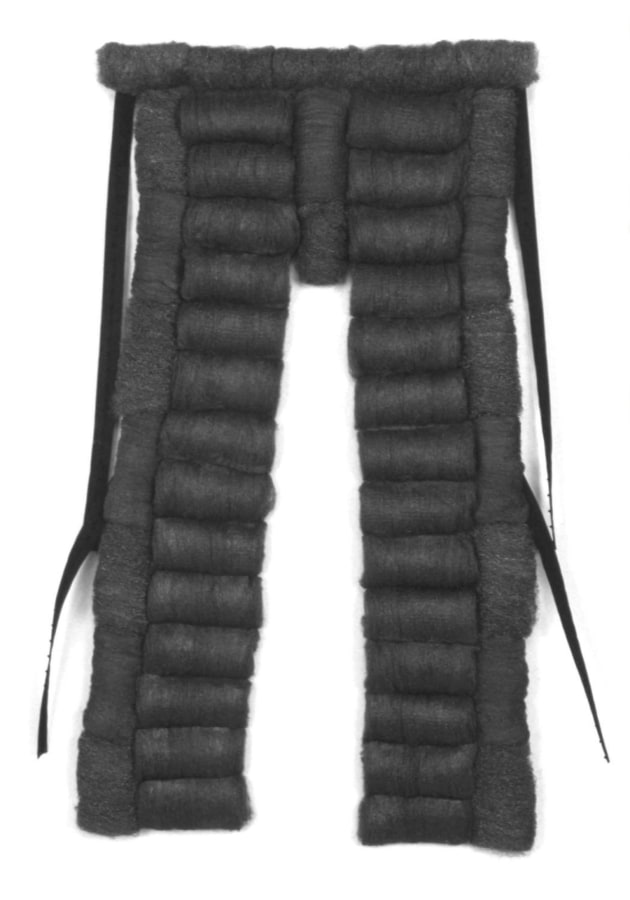
Coverings for an Environmental Crisis, 1992 constructed from aluminum screening, hooks, and steel wool—a domestic object used for scrubbing away grit, grime, and grease—serves as a powerful layer of meaning. The tough, scratchy steel wool contrasts lace, satin, and even soft wool—fabrics typically associated with feminine clothing. This juxtaposition portrays the less-than-romanticized labor associated with marriage and domestic life, which once was the sole role of women. It also alludes to the grit, body of armor, and hard work needed to tackle the environmental crisis.
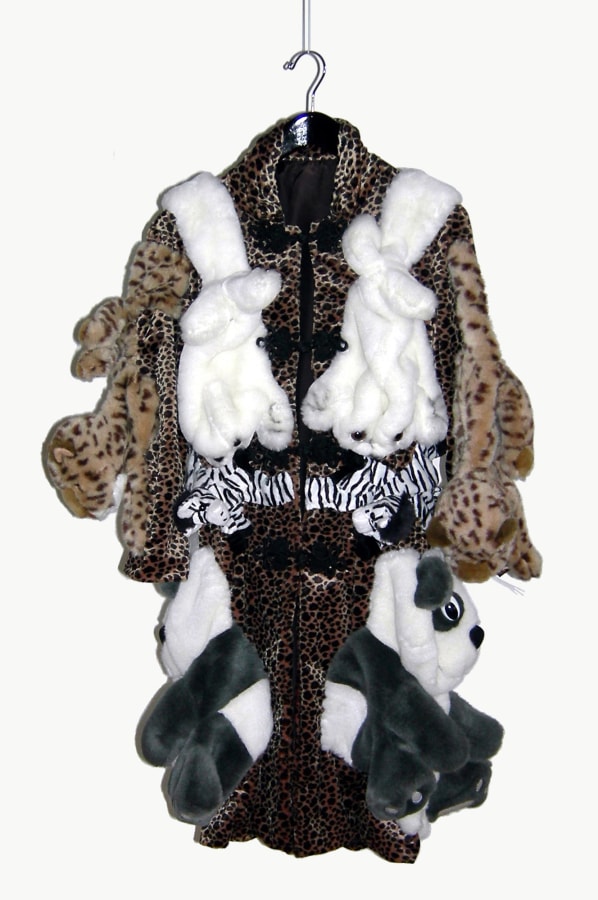
In another work, Endangered Species Coat, 2007 Smith constructs a coat of plush endangered animals as a symbolic representation, speaking to human behavior, habits, and consumption that have led to the extinction not only of species but of our environment. This piece harks back to the time when women, as symbols of wealth and prestige, flagrantly wore coats made from rare animals. Today, with harsh criticism and loud activism this fashion trend is dead. Yet, the swift-shifting pace of fashion trends today causes equally, if not more, environmental harm to species on our planet.
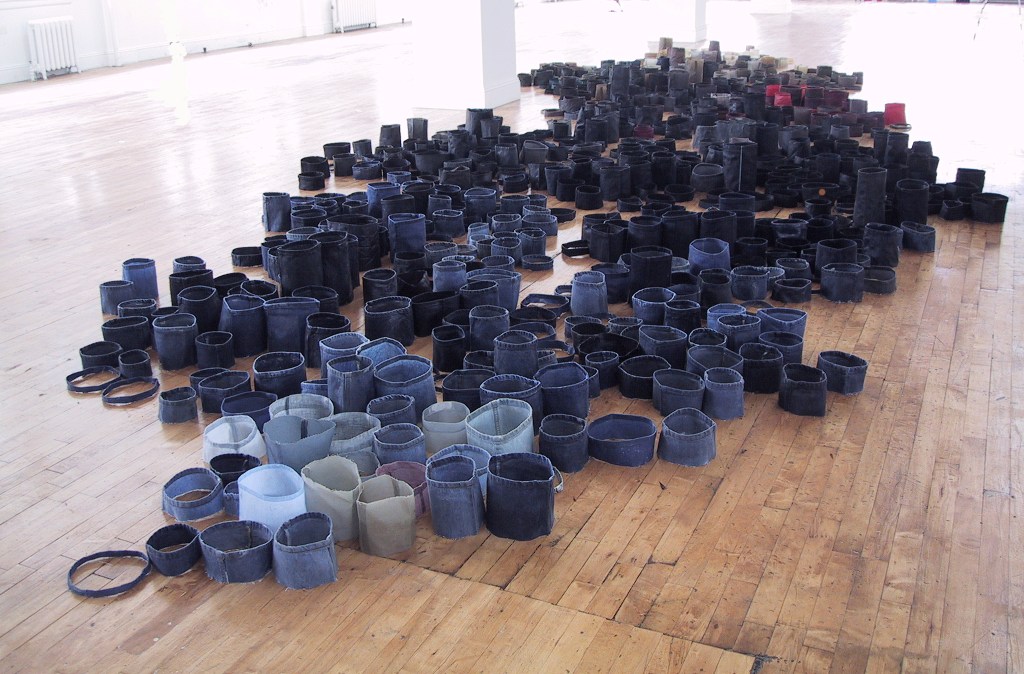
Denim is as American as apple pie, though it’s not all glossy imaging of cowboys and Marlon Brando. Rooted in slavery and produced with environmentally damaging processes, it is also a symbol of America’s dark side. It is known for high water usage, energy consumption, and toxic chemical pollution. In fact, it is one of the most environmentally damaging productions in the fashion industry. Artist Jean Shin’s installation Alterations, 1999 is composed of the discarded, trimmed off cuffs from jeans. Each conical denim remnant is wax-stiffened and displayed as a colony. While the artist’s intention was to emphasize that most people’s size doesn’t measure up to fashion industry standards, it equally is an obvious display of waste created in the denim industry.
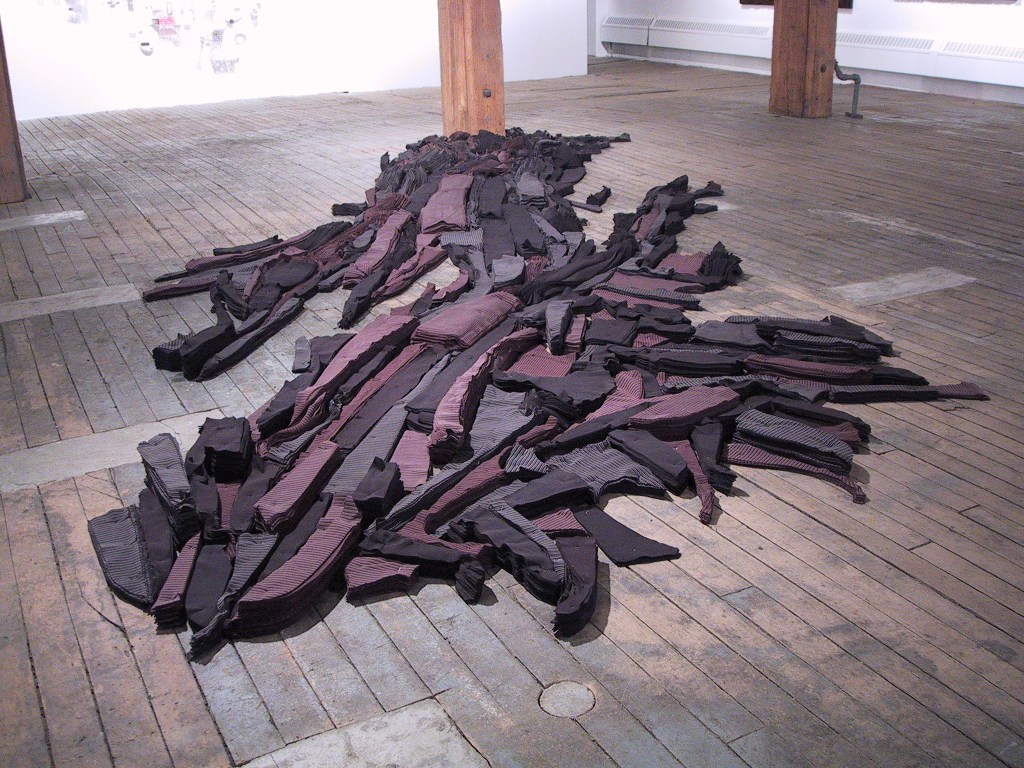
In Nightscape, 2001 Shin arranged dark colored fabric remnants gathered from garment manufacturers to create an art piece that mimics a flowing river, echoing the waste stream prevalent in the fashion industry.

In The Museum Body, 2024 and Cut Outs and Suspended Seams, 2004 Shin deconstructs, reconstructs, and reassembles garments donated by museum staff: curators, conservationists, educators, executive leadership, and facilities staff, creating an egalitarian installation that collectively honors a democratized portrait of the people who hold the institution together, breaking apart the seams of the hierarchy of everyone’s involvement. It becomes a colorful collage of the people.
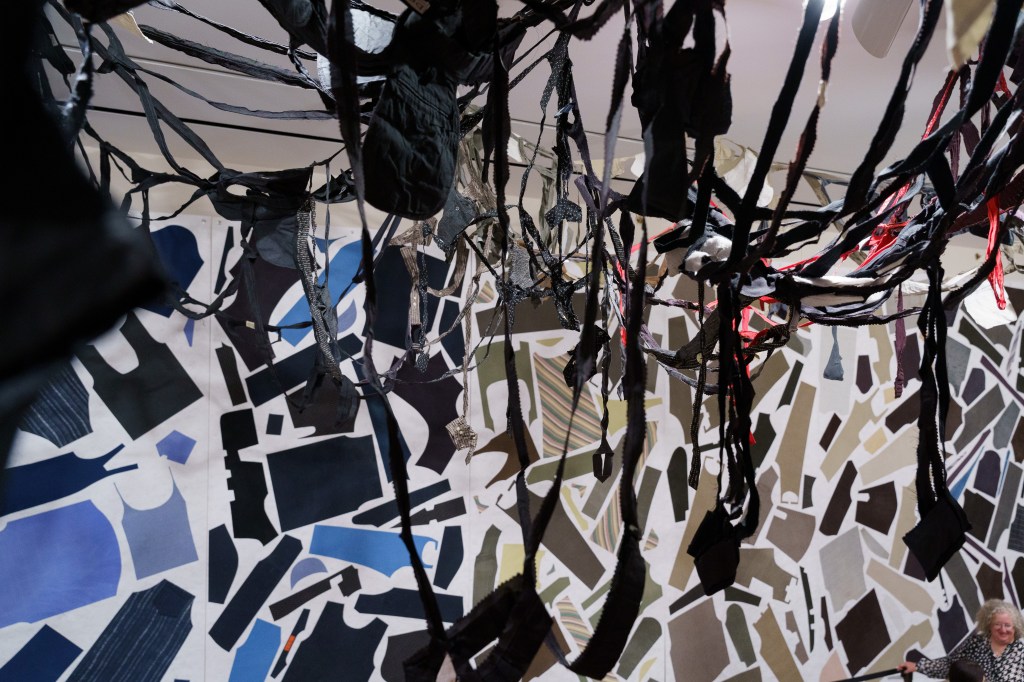
Shin has said that she is attracted to the discarded garment remnants because they embody histories. Rather than scavenging the streets for these rejected items, she asks friends, family, and colleagues for donations. Through a labor-intensive process of cutting, tearing, sewing, and reassembling socks, sweaters, clothing, and fabric remnants she creates a new story to these deemed useless and thrown-away objects, embedding them with a collective history, and as such a story of human consumerism and identification.
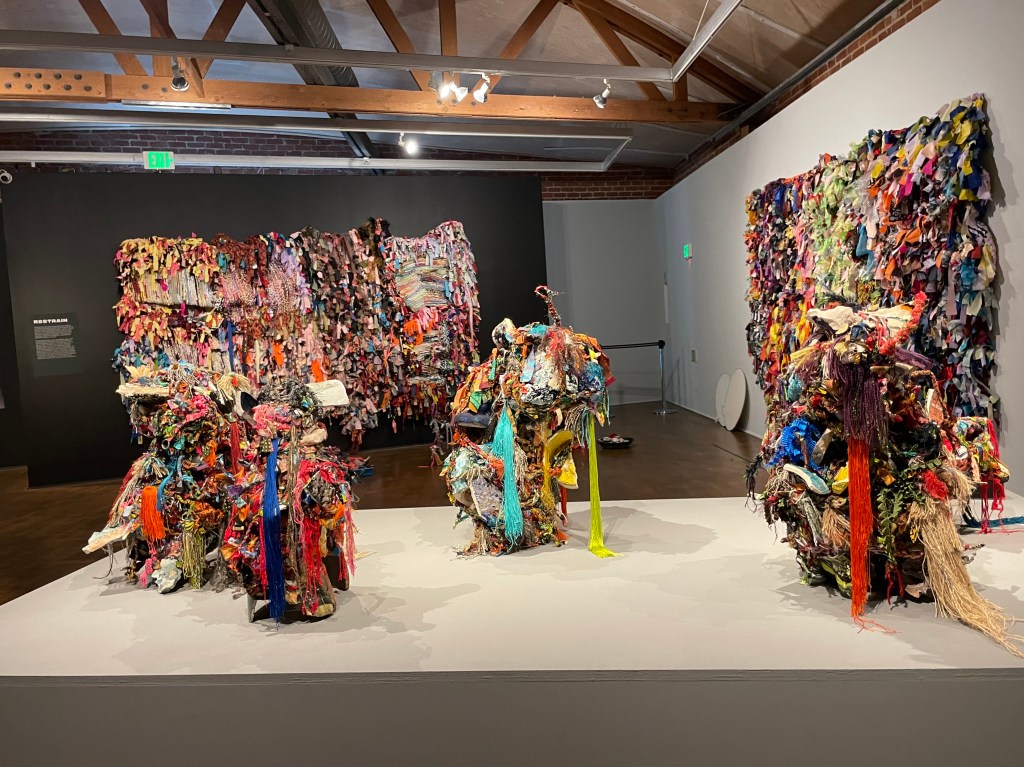
Ramekon O’Arwisters creates colorful, amorphous sculptures from broken shards of ceramic and torn pieces of fabric. In assembling these fractured elements, he forms a beautiful metaphor: despite our brokenness—our tattered, worn pieces—there is profound beauty in the what comes whole, again—anew.

O’Arwisters’ art has been associated with the philosophy behind kintsugi. Having spent time in Japan, he may have absorbed aspects of this aesthetic and ideology. In Japan, art is deeply embedded in everyday life—what we do, what we share, and how we live. This ethos resonates in O’Arwisters’ practice, where life breathes life into form. Each sculpture is infused with personal and familial history, cultural reflections, and political meaning, all stitched into every piece of fabric and transformed into a beautiful, evocative object.
Like others mentioned in this piece, O’Arwisters was deeply influenced by his mother, and grandmother, who quilted and sewed his clothes. This left a lasting impression, nurturing a reverence for memory, labor, and history woven into textiles.
His sculptures entice viewers to reconsider the value of ‘imperfection,’ encouraging a mindset of mending rather than discarding. Instead of restoring objects—or ourselves—to some ideal of ‘perfection,’ O’Arwisters invites us to allow something new, layered, and honest to emerge. Embracing imperfection as a part of an object’s (and human) history.


Much like the work of artists Smith and Pym, O’Arwisters’ art took form as a social art movement. I first encountered his work through “Crochet Jams”—collaborative gatherings where he led participants in collectively created fabric-based art. These events offered a form of art therapy, a communal experience connected by strips of fabric woven together into a piece reminiscent of a rag rug—simple and beautiful.

Mansur Nurullah, too, gravitates toward found textiles and thrown-away clothing, handbags, and shoes which he stitches into quilt-like wall hangings such as Thanatos, 2017-18 and Blue Flowers, 2015. His colorful and laboriously crafted works evoke the tradition of quilting, preserving lived personal and communal histories through fabric. Each piece becomes a testament to life, labor, and love, elevating discarded materials into storied, communal works of art.

American sculptor Charles LeDray is renowned for his meticulous, handmade sculptures of clothing. Unlike artists who repurpose existing clothing, LeDray hand-stitches, casts, and hand-crafts every element—from shirts, jackets, and trousers to buttons, gloves, hangers, and even push pins. Many of his works take several years to complete. Each of his lifelike sculptures are made in miniature, doll-sized scale, they tell a story of personal and cultural history, symbolically stitching together the private and public meanings humans hold in objects. Though fashioned in the everyday designs of functional uniforms and men’s wear, the miniature scale creates an imaginary realm, inviting us to explore the nuances of identity and memory embedded into the garments that we cast away.

Freedom Train (2013-2015) exemplifies his dedication to detail. Crafted entirely by hand from the push pins to the coat hangers and each neck tie, even the dust from his studio floor incorporated into the piece.
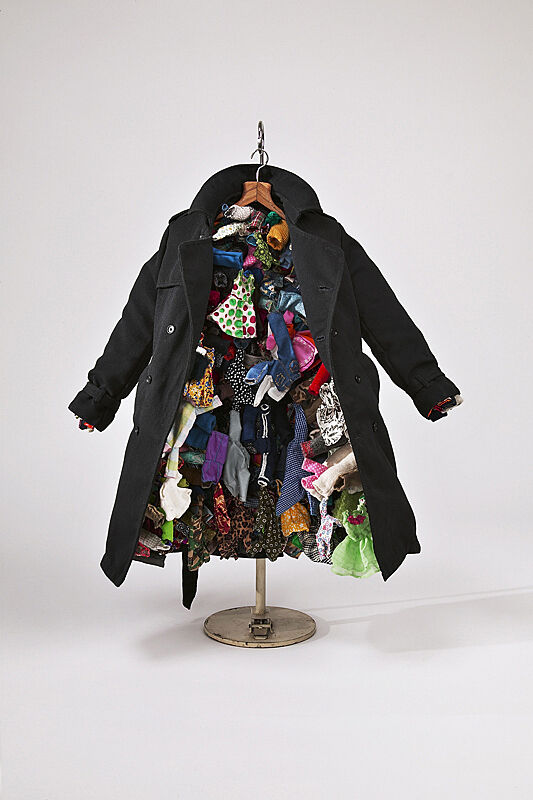
Overcoat (2004) a striking art piece, is a child-sized replica of a black, militaristic trench coat, displayed opened to expose hordes of even smaller men’s and women’s garments inside. (I can’t resist recalling the character Mother Ginger from The Nutcracker, in which the miniature clothing concealed in Overcoat reflect the Polichinelle children hidden underneath Mother Ginger’s gown.) Was he inspired by Marilyn Pappas, Opera Coat, from 1968? LeDray’s many years as a museum guard and art handler, surrounded by all kinds of art, likely played into his subconscious influencing his own creative process.

In today’s fast-fashion culture, LeDray’s labor-intensive art serves as a symbol of nostalgic, meticulous craftmanship—qualities found in the fine detail of personally tailored garments, more often accessible primarily to the wealthy. Conversely, on the other hand, his sculpture represents the overabundance of mass-produced clothing that finds its way to the thrift stores before ultimately ending up in a landfill. LeDray’s work touches on themes of social and economic class associated within the fashion industry, prompting what is lost, what remains, and what endures.
Art can raise consumer consciousness. It can raise awareness and change the way we think, shop, and dress.
The artist featured here remind us that every stitch, thread, and scrap of fabric is deeply human and has a story—and a cost. They confront us with the realities of fashion’s wastefulness. Through their hands, the discarded becomes art. The forgotten becomes remembered.
From this awareness we can discover an awareness and options for alternative paths towards sustainability, care, and creativity.
*Most definitely not an exhaustive list of restyling, repurpose, and slow fashion resources:
Maria Kondo—whom I affectionately call the saint of intentional purchasing and repurposing—offers some valuable resources for slow fashion.
Acteevism is another great resource for slow fashion inspiration.
If you’re looking for a movie to watch, the ADJOAA website provides some suggestions.
And, Fashion Revolution is an organization that raises awareness of the fashion industries most pressing problems and strives for action-oriented and solution focused systemic changes.
Finally, host a clothing swap party.
 ahhtobehumble.com