Art for Earth
A group Exhibition on Nature, Earth, and the Universe
A portion of Auction proceeds in support of Earthjustice
150 Post Street
San Francisco, California
November 4 -21, 2026
Opening reception November 4, 5-8PM
Under our feet, above in the skies, and within our vision we are witnessing a changing natural world. What we once understood as natural is changing, has shifted, and a distorted natural world is forming into a new reality of nature. It is hard to imagine a place where man has not impacted and shaped nature. Each alteration becomes ordinary, a new familiarity. We hold onto what once was, as nostalgia, quaint, lest it be forgotten.
Before long, nobody will remember star gazing without satellites, or backpacking without the sound of airplanes overhead. Are we losing sight of and becoming unmoored from our memory of nature?
Human impact on the environment has triggered profound, geological-scale shifts, climate change, soil erosion, poor air quality, extinction of species, and undrinkable water, among other effects. Some of these can be mitigated, others are irreversible alterations on the natural world.
Agriculture and urbanization, destruction of ancient wetlands and old-growth forests have transformed and shaped our land, much of what cannot be undone.
Considering today’s challenges, humans’ obsession with convenience and instant gratification is a significant concern for our planet. Corporate manipulation to feed that hunger leads to providing fast one-click response to whatever we might desire either in information or consumer products. This is fueling an obsessive AI race to ‘get there first’ which leads to a rush for land to build data centers, offshore oil drilling, groundwater sourcing, and who can own power, in the form of supplying the grid. Who is there to protect the earth?
As we reach for the moon, as our next place to exploit for our insatiable need for more knowledge at our fingertips, have we considered how space junk will impact our ecosystem? The moon is critical to this earth, its gravitational pull stabilizes our planet’s axial tilt, which prevents extreme climate shifts and tides, it stabilizes seasonal weather conditions. Lunar cycles guide animal migration, coral spawning, and plant growth. How will the increasing number of satellites and defunct objects and pieces of space debris scattered in Earth’s orbit affect weather, GPS, and disrupt daily terrestrial infrastructure?
People think of space as vast and empty, people thought of whales as an unending bounty in the sea, people thought of trees as an unlimited resource. People thought wrong.
In this group of art works, the artists each take a different approach to sharing their love, connection, and relationship with nature, earth, and beyond this planet into our universe and multiverse. They nostalgically reflect on the past, and contemplate possible futures. They allow the viewer to see into our coexistence between all life, terrestrial and celestial.
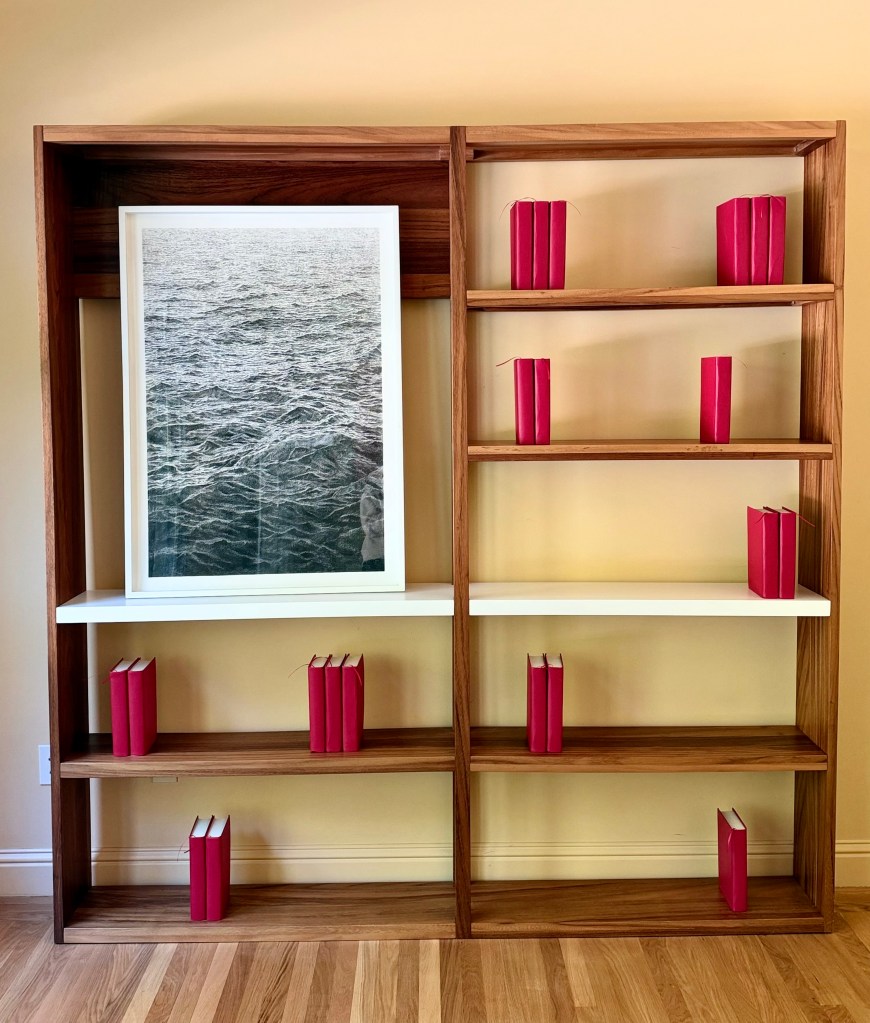
Monumento Melville/ Melville Monument by Jorge Mendez Blake, beckons back to the philosophical and timeless themes of human obsession, fear, and our unsustainable relationship with the natural world—Ideas Herman Melville captured in his monumental masterpiece, Moby Dick. The 21 books in Blake’s sculpture could reference the pivotal chapter in Moby Dick when Ishmael and Queequeg got aboard the ship for the infamous journey in search of the great white whale. In each of the books in Blake’s sculpture are the more than 300 sentences drawn from Melville’s writings of the sea.
Let us begin in 1851, when Melville published Moby Dick. The hunting of whales (known as whaling) had become a major and lucrative commercial industry. Whales were slaughtered for their blubber, which fueled the machinery of the Industrial Revolution and lit the “fat lamps”. Nantucket, Massachusetts, where the story of Moby Dick begins, became the whaling capital of the world, earning the nickname, “The City That Lit the World.”
From the mid-19th century, when approximately 8000 whales were killed annually, to today, when around 1,200 are killed in a single year, the journey to save the whales has been as turbulent as the seas. At that time, it was thought there was a limitless number of whales, so abundant it was believed whaling could never significantly diminish their populations. The first efforts of regulating the hunting of whales in the1920s were motivated to protect the whaling industry rather than protecting the whales themselves or the broader ecosystem.
As faster boats, new technologies, and harpoon guns accelerated the slaughter, the International Whaling Commission was formed in 1946 in an effort to slow the rapid depletion of whale populations. Yet the system further commodified whales as currencies, with quota limits placed on different species. This ultimately contributed to the outrageous scale of commercial whaling that followed, reaching a peak in the 1960s, when an estimated 70,000-80,000 whales were killed each year.
Finally, a radical shift happened in the 1970s. Greenpeace and the “Save the Whales” campaigns transformed the public perception of whales as an industrial commodity into being seen as gentle and intelligent animals, sentient beings worthy of protection, and as fellow inhabitants of a shared planet whose presence is important for our ecosystem.
Moby Dick is more than a story about the plight of a whale. It is also a profound meditation on human obsession, revenge, and the consequences of an unsustainable relationship with the natural world. In this sense, Blake’s Monumento Melville serves as a reminder, not only of an epic work of literature, but also of what has changed and what has not in our relationship with nature.
Jorge Mendez Blake, a mixed-media conceptual artist from Guadalajara, Mexico is an architect by professional training and turned to visual arts that revolves around literature and architecture. He believes that “writing is itself a kind of construction and reading is a way of creation… [and] art is a way to write without using the regular tools of the writer, it’s a type of language.” He transforms the written word into paintings, drawings, and sculptural forms creating in a sense, monuments that pay homage to literature.
Blake has been the subject of solo exhibitions in many museums, including a commission for the Bass Museum in Miami (2022); the Museo Tamayo (2020); and the Museo do Arte Moderno (2019); Marfa Contemporary (2017); the Kuntshalle Mulhouse (2025), the Museo Universitario Arte Contemporáneo (2015); the Museum of Contemporary Art Denver (2014); to name a few, and his work has been a part of numerous museum group shows.
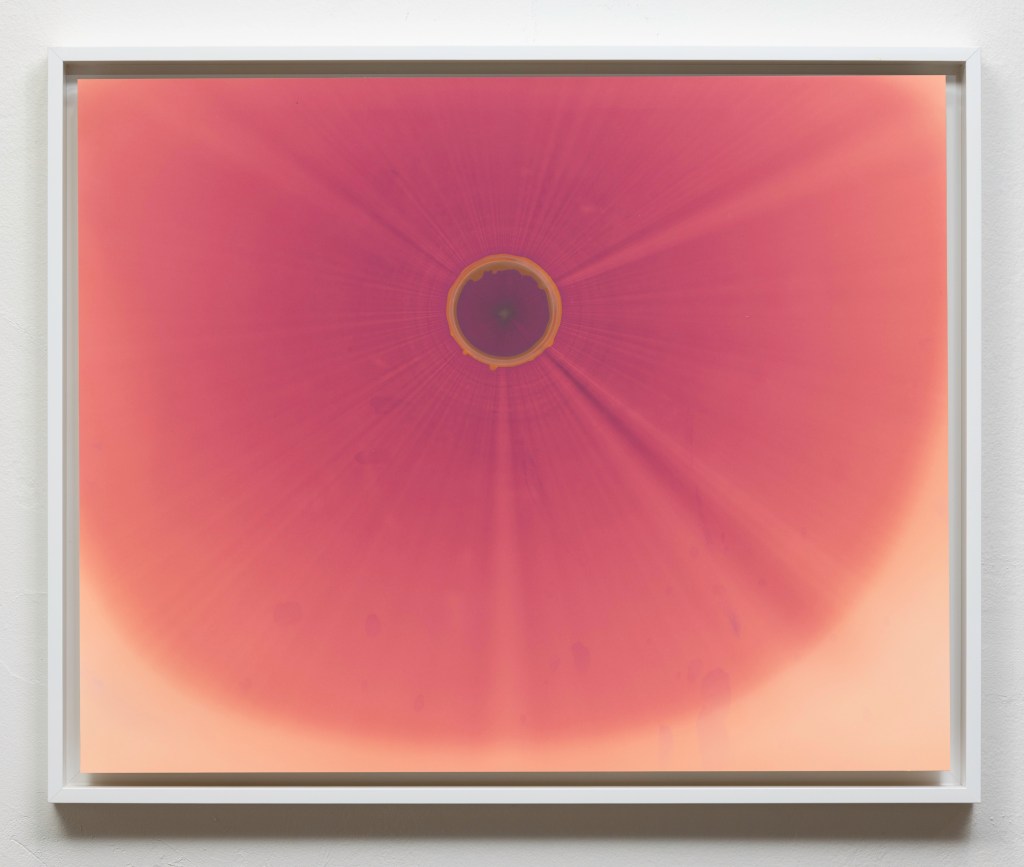
What makes for a beautiful sunset? We’ve all heard the familiar refrain: it’s the smog that makes California sunsets so beautiful. Yet the spectacle is more complex. As sunlight travels through the atmosphere, the longer wavelengths of red, orange, and yellow light refract and scatter. And cast over the ocean, the sea becomes a mirror, shimmering back up into the sky. The ocean doubles the beauty. It stretches the horizon, blurring the boundary where sky meets water.
And, within that spectacular beauty: dust, and sea salt, and smoke, and tiny plastic particles.
Scientist have increasingly alerted us to the saturation of micro-and nanoplastics in our marine environments. More recently, they have discovered these particles move faster through the atmosphere, carried through the air we breathe. Like climate change and hazardous chemicals, much of this plastic pollution is imperceptible to the naked human eye, and their impact goes relatively unseen.
It is this tension between the visible and invisible that Francis Baker explores in his photography.
For What Concerns a Sunset Baker allows sunlight to shine through discarded plastic onto darkroom photographic paper during a long exposure. Much like plastic particles suspended in the atmosphere refracted in long wavelengths of light, the outcome creates a range of intensifying brilliant hues. Physically, the sun’s rays alter the structure of the darkroom photographic paper, producing structural colors. What the viewer sees is electrifying, surreal—beautiful. And yet there is something eerie in that beauty, one could say unnatural.
This is the paradox of our heating planet: the man-made forces transforming the natural world can also produce the extraordinary. Greenhouse gasses are produced at every step of a plastic’s lifecycle. Meanwhile, microplastics have permeated the air, water, soil, and the food chain—often invisible to us even as they become increasingly ubiquitous.
Baker makes this invisible transformation visible—not by blatantly illustrating contamination, but by allowing it to reveal itself through light and his lens.
Francis Baker is an Oakland-based artist and photographer whose work explores the impact of consumer culture on people and the environment. He creates images without a camera, directly on photographic paper using sunlight and discarded single-use plastic. Drawing on a background in physics and decades of self-directed practice, he subverts historic techniques like gum bichromate and gelatin silver printing, incorporating found materials. His layered works merge physical texture with conceptual depth, connecting themes of environmental degradation, personal history, and resilience. Baker’s work has been widely exhibited, including at the de Young Museum, YBCA, Bakersfield MOCA, and Marin MOCA.
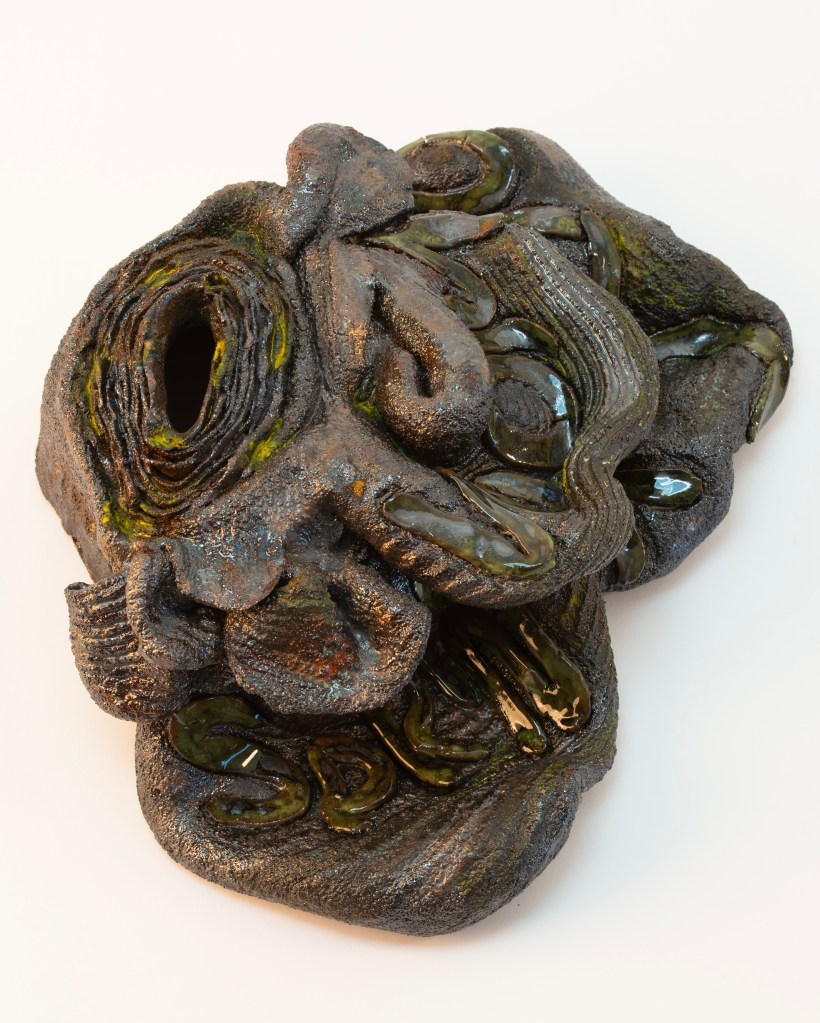
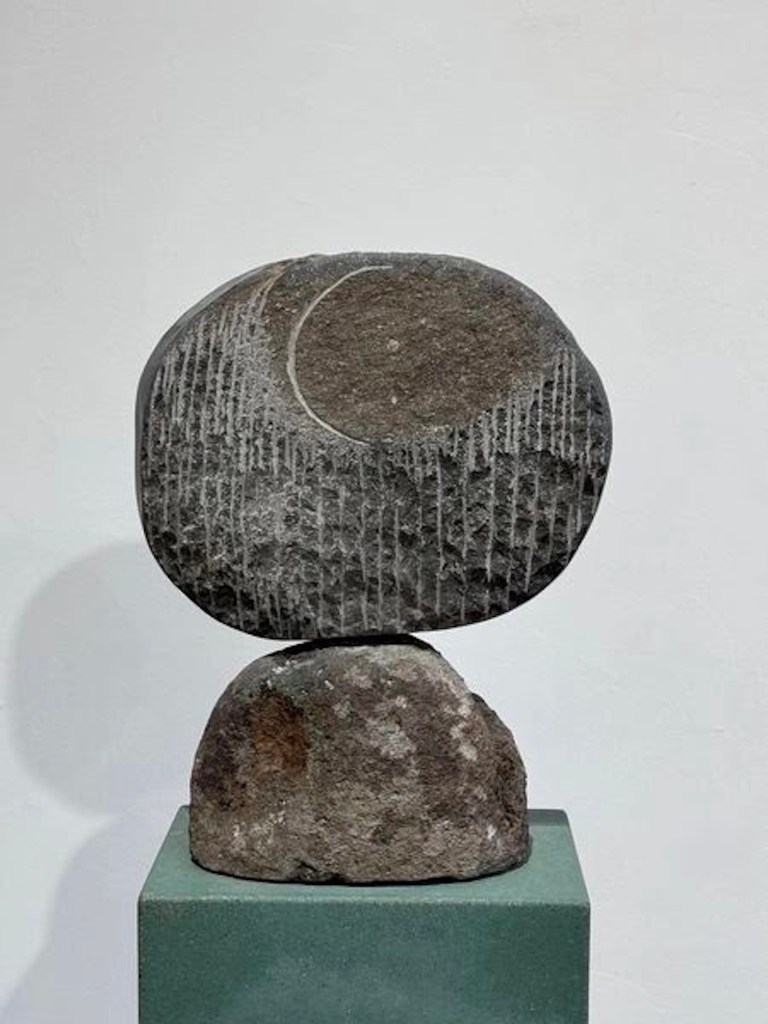
Ashwini Bhat’s creative background was formed through classical Indian dance and literature, evolving into a multidisciplinary artistic practice encompassing sculpture, ceramics, installation, and performance. She explains, “As a transdisciplinary artist, I’m interested in ecology, place, and a metaphysical understanding of nature and self.” Her art is an expression of the relationship between the body and self, as well as between the physical and spiritual worlds.
Rock Spring Moon (Circumambulation of Mt. Tamalpais) is a part of Assembling California, an ongoing artistic investigation which began in early 2018. Bhat’s inquiry into the microclimates around Mt. Tamalpais in Marin County, lead her to ponder how all is interconnected. Describing the sculptural composition, Bhat says it, “celebrates the secular, sacred, human, and non-human environment of the mountain.”
There is, indeed, something sacred about Mt. Tamalpais. In the 1960s, poets Gary Snyder, Allen Ginsberg, and Philip Whalen began a clockwise hike around the mountain as a form of ritualistic meditation, inspiring generations of others to follow in their footsteps, to this day.
Rock Spring Moon (Circumambulation of Mt. Tam) depicts a turkey tail mushroom that Bhat encountered on the Rock Spring Trail, during one of her circumambulation walks with her partner, eco-poet Forrest Gander. The sculpture captures the intricate folds and concentric rings of the fungus. Its subtle glimpses of shades of green and red evoke a natural patina, as though it has slowly formed over centuries.
Ashwani Bhat’s work is exhibited nationally and internationally and can be seen in the collections of the Asian Art Museum, San Francisco; Crocker Art Museum, Sacramento; University of Michigan Museum, Ann Arbor; Newport Art Museum, Rhode Island; Kiran Nadar Museum of Art, India; and Shigaraki Ceramic Culture Park, Japan, among others.
Carolina Caycedo’s art practice seeks to raise awareness of how groups of people reconstruct historical and environmental memory. She probes into colonialization and the corporate privatization of water and land, specifically the desire to dominate nature that drives many large-scale-private and governmental projects. These exploitations often generate inequities and injustices both among human communities and towards other living beings. At its core, Caycedo’s work envisions and demands an environmental justice that embraces all forms of life.
Her multifaceted practice encompasses photography, sculpture, installations, performance, films, and books. Across these mediums, she explores our relationship with past and present, with one another, and with all living beings who share this planet.
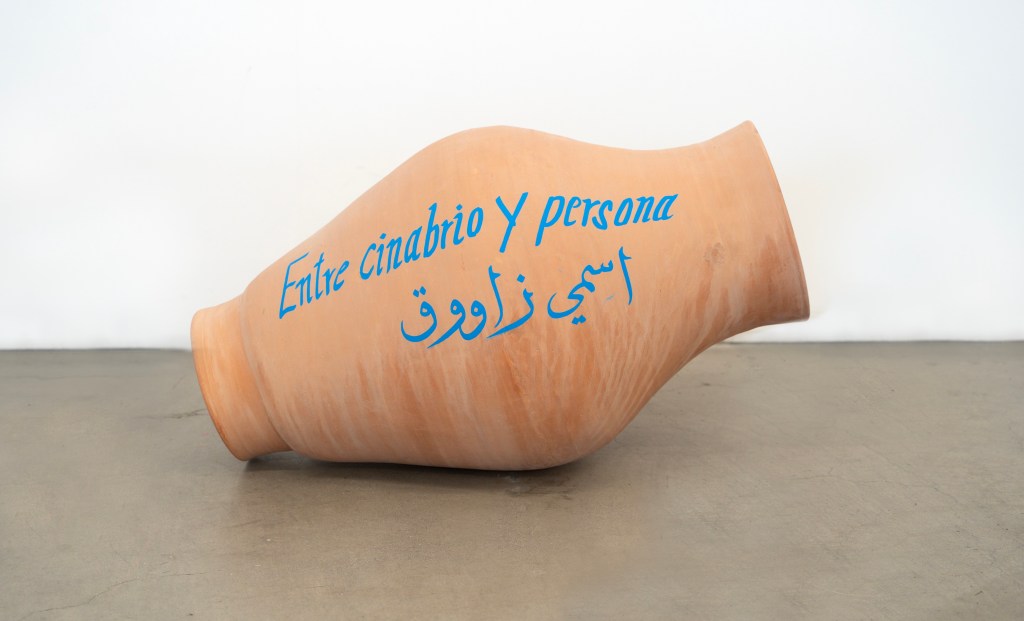
The following text, written by Carolina Caycedo, provides a broader context for Entre cinabrio y persona – Between cinnabar and person.
Entre cinabrio y persona is part of Caycedo’s Agua Pesada/ Alma’ Althaqil (2023) installation for the Sharjah Biennale. Agua Pesada is inspired by the aludeles (bottomless-pot furnaces) of the Almadén mercury mines in Spain, the largest and most prolific mercury concentration in the world. The immersive work features 240 replicas of aludeles arranged in rows atop a v-shaped platform that the audience can walk through. Glazed Arabic and Spanish calligraphy inscribed on the furnaces relays the origin of the Spanish word azogue (mercury), which has roots in Arabic, as well as the history of mercury from its early extraction in the Almadén mines to the recent Minamata Convention.
Mercury, often called quicksilver, is known as azogue in both Arabic and Spanish. Beautiful yet toxic, it is a mineral of contradictions: harmful and useful, dangerous and indispensable. It has long been employed for scientific, industrial and technological applications. Mercury occurs in the environment by natural and anthropogenic pathways. Naturally, it occurs in the environment by volcanic activity, weathering of rocks, forest fires and the evaporation stage of the water cycle. Anthropogenically, it occurs from burning fossil fuels (coal), cement production, manufacturing of medicinal products, waste incineration and mining of gold.
Yet mercury in all forms is toxic to humans. Exposure can harm the nervous system, kidneys, and cardiovascular system. Once released, mercury carries into the atmosphere, through the air and eventually deposited into water and/or onto land. It stays in the environment for long periods of time, cycling between air, soil, and water.
Caycedo extensively researched into mineral mining, with particular attention to human labor and environmental consequences of mining. Cinnabar, the principle ore from which mercury is extracted, has been mined for over 2000 years, dating back to Roman and Moorish times. The name Almadén itself derives from the Arabic al-Ma’din, meaning “the mine”.
Through this work, Caycedo invites us to reconsider the past and present relationship with the minerals of the Earth—and the human and environmental costs embedded in their extraction. The inscription on the pot is part of poem co-written by Caycedo and Daniel H. Rey, its verses written across a selection of the pots.
Caycedo’s use of the aludel in form and using Arabic and Spanish calligraphy on the pot brings together technology, language, extraction, and cultural memory. The pot is a bearer of cultural and environmental memory. It can be seen as a carrier of knowledge: objects through which histories of scientific ingenuity, cultural exchange, colonial exploitation, human labor, and environmental harm are made visible.
Carolina Caycedo born in London to Colombian parents, grew up in Bogotá and lives in LA. She received an MFA from University of Southern California (2014) and a BFA from Los Andes University, Bogotá (1999).
Her work has been featured in numerous solo shows and in major international exhibitions, incuding: Vancouver Art Gallery (2026); Nevada Art Museum, Reno (2026); 61st Venice Biennale (2026); Tate Modern, London (2025); The Brick, Los Angeles (2024); The Clark, Williamstown (2023); 15th Sharjah Biennial (2023); Serpentine Galleries, London (2022); El Museo del Barrio, New York (2021); Museu de arte de São Paulo Assis Chateaubriand (2019); Centre Pompidou, Paris (2019); Hammer Museum, Los Angeles (2018); Whitney Museum of American Art, New York (2018); Los Angeles County Museum of Art (2017); and Seoul Museum of Art (2017). And her work is in many prestigious private and museum collections.
Caycedo is a recipient of United States Artists Fellowship (2023), Latinx Arts Fellowship, Mellon Foundation (2021), Borderlands Fellowship (2020), Creative Capital Visual Arts Award (2015), and Harpo Foundation Visual Artist Grant (2015). Caycedo has participated in residencies at Getty Research Institute, Los Angeles (2024); Denniston Hill, New York (2023); Wanlass Artist in Residence, OXY ARTS, Los Angeles (2020); and FAAP São Paulo (2016).
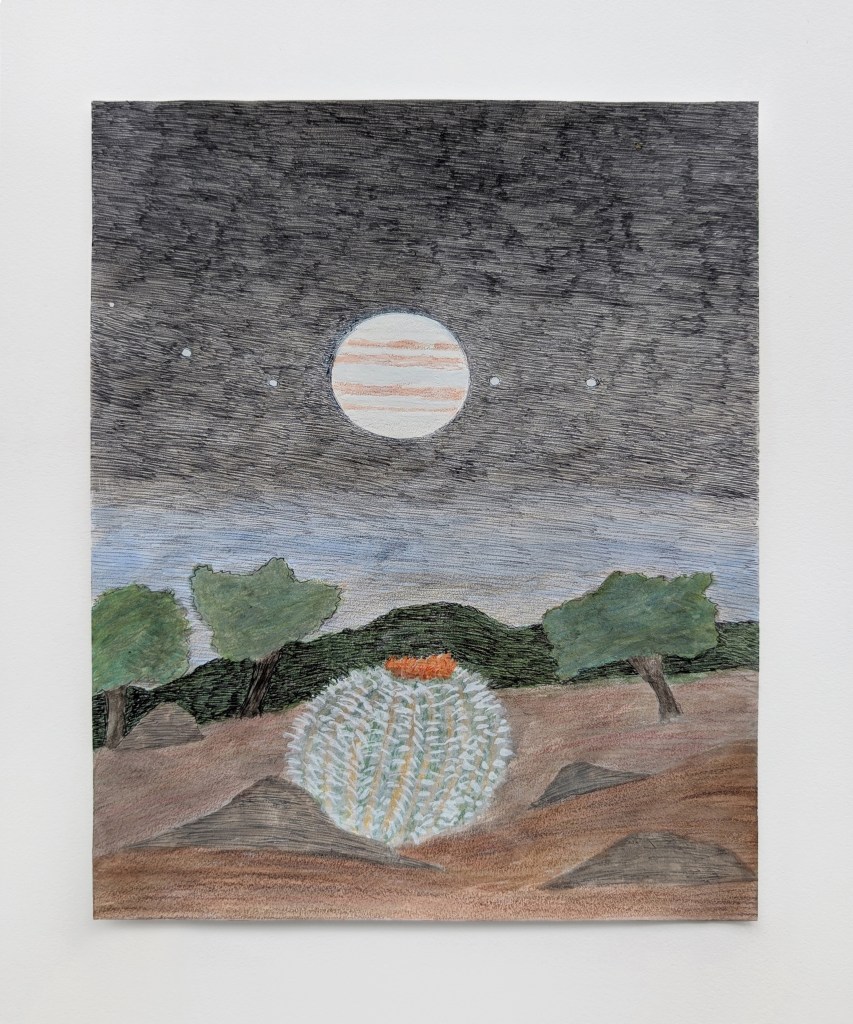
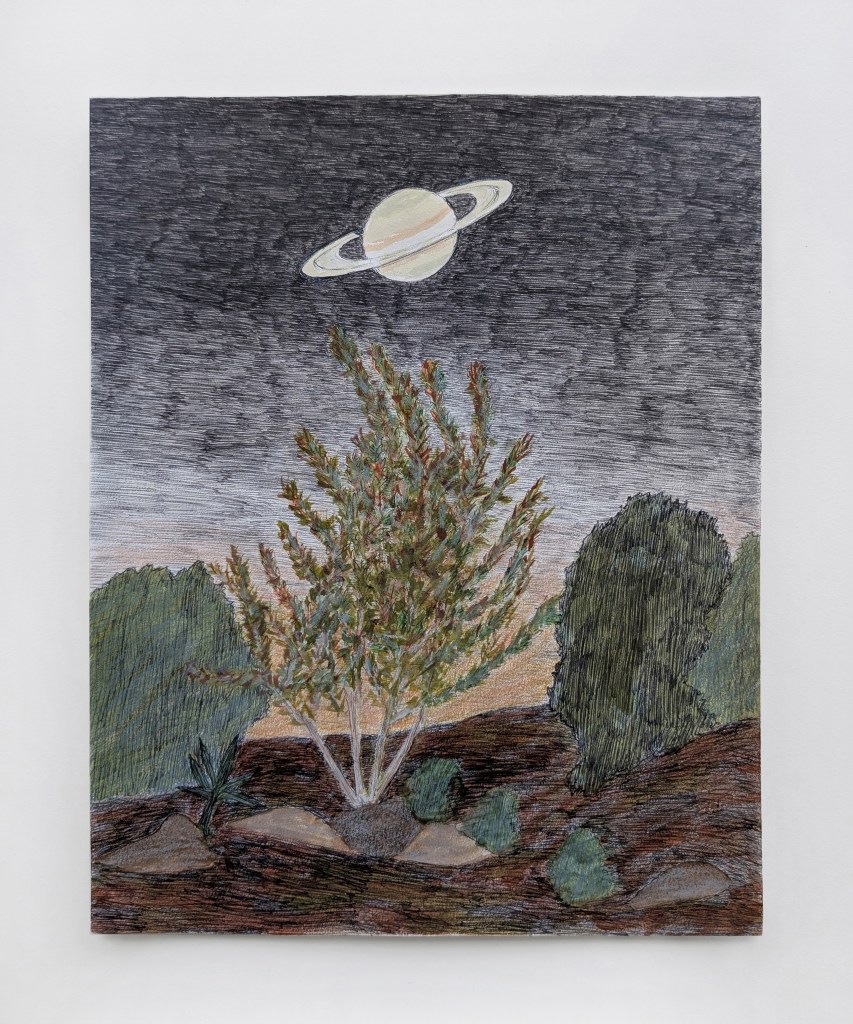
Russell Crotty grew up in Marin and Mendocino counties with nature as his playground. He spent his formative years wandering the coastal trails, surfing the jagged edge coastlines and gazing up into the night skies. He began drawing in his teens and continues on today, capturing his passion for nature, astronomy, and surfing. His pen on paper drawings offer an intimacy of a personal journal, reflecting on a place, a moment, a feeling. The drawings are obsessive and detailed, often researched as much as interpretative.
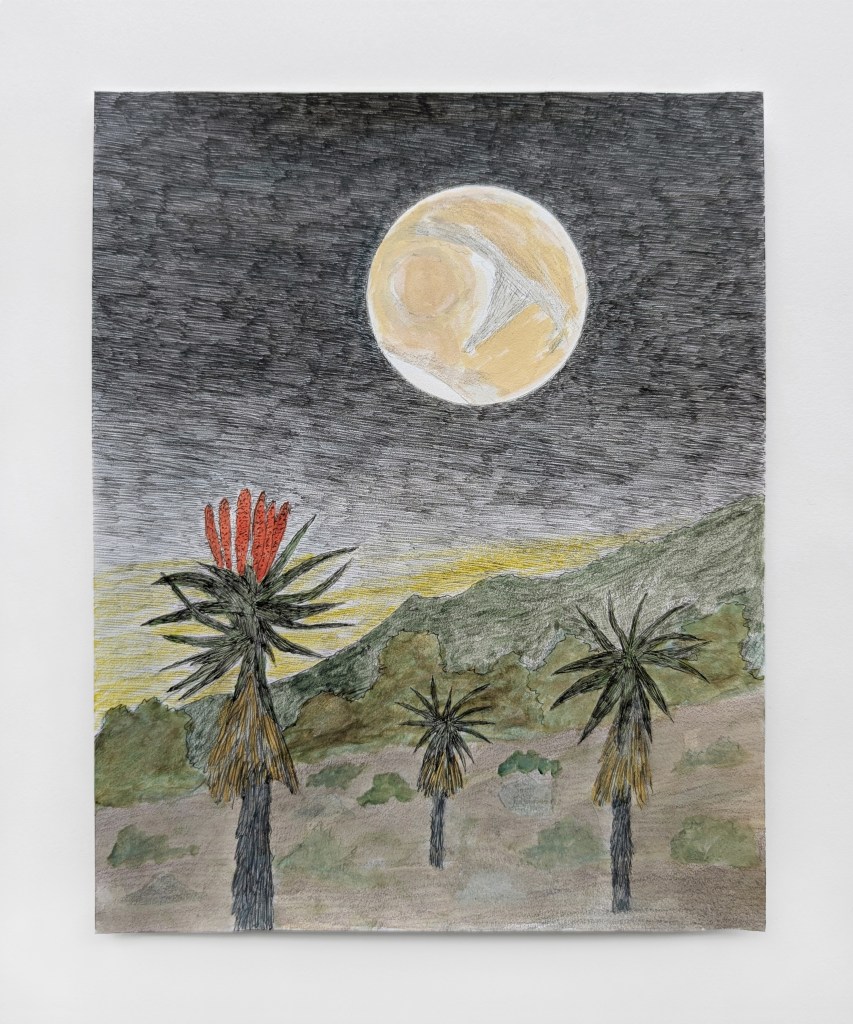
In these three drawings—Barrel Cactus with Jupiter, Blooming Aloes with Mars Opposition, and Saturn Above the Autumn Gardens—Crotty harmonizes the terrestrial and celestial, capturing memories of his time spent keenly observing the plants and night sky while wandering around Taft Gardens and Ojai. There is sense of a personal connection to nature in these drawings, sketched with a bit of whimsy and dreaminess. While they are small in scale, they represent something bigger, the grandeur of the interconnection of our life on this small, yet significant planet to all life in the galaxies. They help us to see the grandeur of our life on this blue planet and its small scale in comparison to the vastness of time and space.
Russell Crotty was born in San Rafael, California, and received his BFA from San Francisco Art Institute with honors in 1978. In 1980, he received his MFA from University of California, Irvine. Today, Crotty lives in Ojai and works in Ventura, California.
Crotty is a 2015 Guggenheim Fellow. He received a 1999 Visual Arts Fellowship from the Peter Reed Foundation, New York and a 1991 Visual Arts Fellowship from the National Endowment for the Arts.
Crotty’s work has been included in prestigious exhibitions including: the Museum of Modern Art, New York; Centre Pompidou, Paris; Turner Contemporary, United Kingdom; The Geffen Contemporary at MOCA, Los Angeles; Hammer Museum, Los Angeles; Institut Valencià d’Art Modern, Valencia, Spain; Fine Arts Museums of San Francisco; Museum of Contemporary Art, North Miami; Museum of Contemporary Art, San Diego; Contemporary Arts Museum, Houston; and Vancouver Art Gallery, British Columbia; and Mt. Wilson Observatory, Pasadena, California
His work is in the permanent collections of many prominent institutions, including Centre Pompidou, Paris; Museum of Modern Art, New York; Whitney Museum of American Art, New York; New York Public Library, New York, NY; Museum of Contemporary Art, Los Angeles; Los Angeles County Museum of Art; Hammer Museum, Los Angeles; San Francisco Museum of Modern Art; Museum of Contemporary Art San Diego; San José Museum of Art; Santa Barbara Museum of Art; Museum of Fine Arts, Boston; Princeton University Art Museum; Harvard Art Museums, Cambridge; Museum of Contemporary Art North Miami; High Museum of Art, Atlanta; Dallas Museum of Art; The Kemper Museum of Contemporary Art, Kansas City; NASA Art Program; and the US Department of State’s “ART in Embassies Program” at the Embassy of the United States, Beijing, China.
Ken Fandell is an artist and teacher whose practice primarily centers on photography, but engages with a variety of mediums, including drawing, video, and sculpture. He currently serves as Michael G. and C. Jane Wilson Chair in Arts and the Humanities at Harvey Mudd College in Claremont, California. Fandell has deep roots in Chicago: he was born in Evanston, received his BFA at the School of the Art Institute of Chicago (SAIC) and his MFA at the University of Illinois at Chicago, and taught for twelve years at SAIC, where he was chair of the photography department.
He has exhibited at Museum of Contemporary Art, Chicago, the Honlulu Museum of Art, the San Jose Institute of Contemporary art, the Ashville Museum of Art. His work is in the collections of the Brooklyn Museum of Art, Museum of Contemporary Art Chicago, Museum of Modern Art NY, and the Ashville Museum of Art, to name a few. He is represented by Traywick Contemporary Gallery.
Fandell emphasizes “intuition and contemplation” as the center of his practice and teaching. “It starts when you let your heart and your head work in conjunction with the environment around you,” he remarked in speaking of his artistic practice.
Art history reveals that artists have found inspiration in clouds for centuries. John Constable, J.M. William Turner, John Cole, and Gustave Courbet are among those who most famously turned their attention skyward. Travel through Europe’s palaces and chapels, and you need only look up to discover masterpieces adorning their ceilings, painted by artists such as Tiepolo or Pozzo. Long before sunsets captured our collective imagination, clouds ever-changing forms, light, and atmosphere held artists in awe.
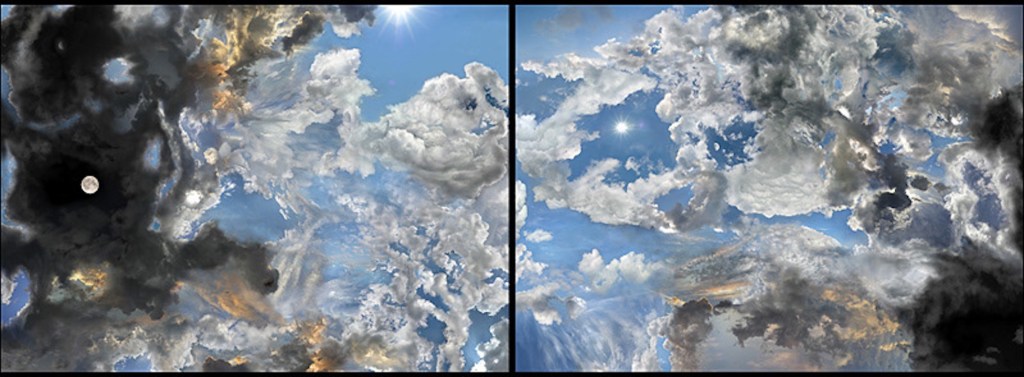
Known for his witty plays on perception, Ken Fandell extends the exploration of clouds in his Skies series, creating mesmerizing montages of cloud-filled skies through the interplay of camera and computer, analog and digital. His work builds upon this centuries-old fascination and takes it to a new level, into a realm of spiritual, aesthetic, and philosophical contemplation.
Days and Nights, Dawns and Dusk, North and South, East and West, Mine and Yours first exhibited at the Museum of Contemporary Art Chicago in 2004. At first glance, the viewer sees a hypnotic swirl of clouds, a sky of exquisite beauty. But linger a moment, and the familiar unravels to something unusual. Night and day coexist; moon and suns share the same celestial space, with luminous full moons and silvery crescent new moons. It’s a psychedelic sky, a hyper-transcendent vision in which the sublime becomes ever more sublime. The viewer finds themselves disoriented, somewhere between nowhere and everywhere, immersed in a sky that transcends geography and time. Whether gazed upon in California or Calcutta, Fandell captures the universality of the sky, something mysterious, boundless, and shared.
His photographs reflect both scientific observation and poetic contemplation. Fandell invites us to reconsider not only what we see, but how we see it, blurring boundaries between the real and the manipulated, the natural and the constructed, and how humans understand their place in and perception of the natural world.
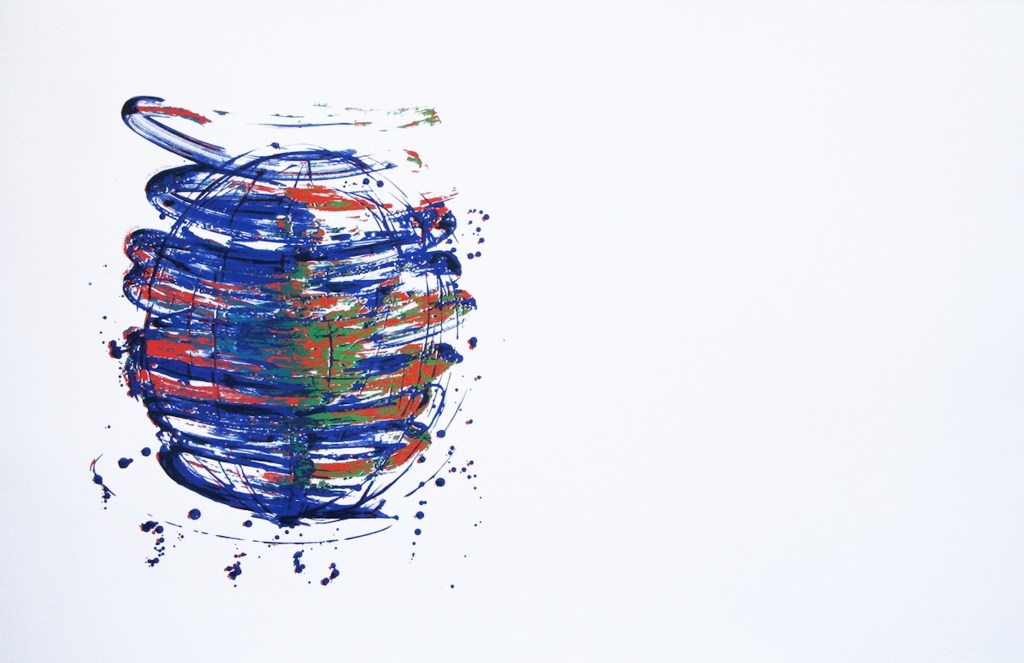
Camino Entre Mundos/ The Crazy Crazy World is a part of Walk Among Worlds a more comprehensive installation project by Maximo Gonzalez that comprised of 7,000 beach balls in three different sizes, printed to resemble Earth globes. The overall concept behind the work was to represent the 7,000 million inhabitants—the global population of the planet. And three sizes allude to the archaic concept of ‘first’ and ‘third’ world nations. We are each a part of a united whole, comprised of our individuality, our cultures, and our multitude of languages. Each contributing to our coexistence, floating in this universe, in a bigger multiverse. We are part of the same organic beautiful vital planet, through the air we breathe. Yes, it’s a magnificently crazy, crazy, crazy world!
Maximo Gonzalez, a mulitmedia Argentine artist who lives between Mexico City and Spain, has shown in numerous solo and group exhibitions in Europe and the Americas, including Fowler Museum, Los Angeles; Hospicio Cabanas Museum, Guadalajara; Casa de America, Madrid; Artpace, San Antonio, Texas; Zacheta National Gallery of Art, Warsaw; San Jose Museum of Art, San Jose, California; Jeu de Paume, Paris, to name a few.
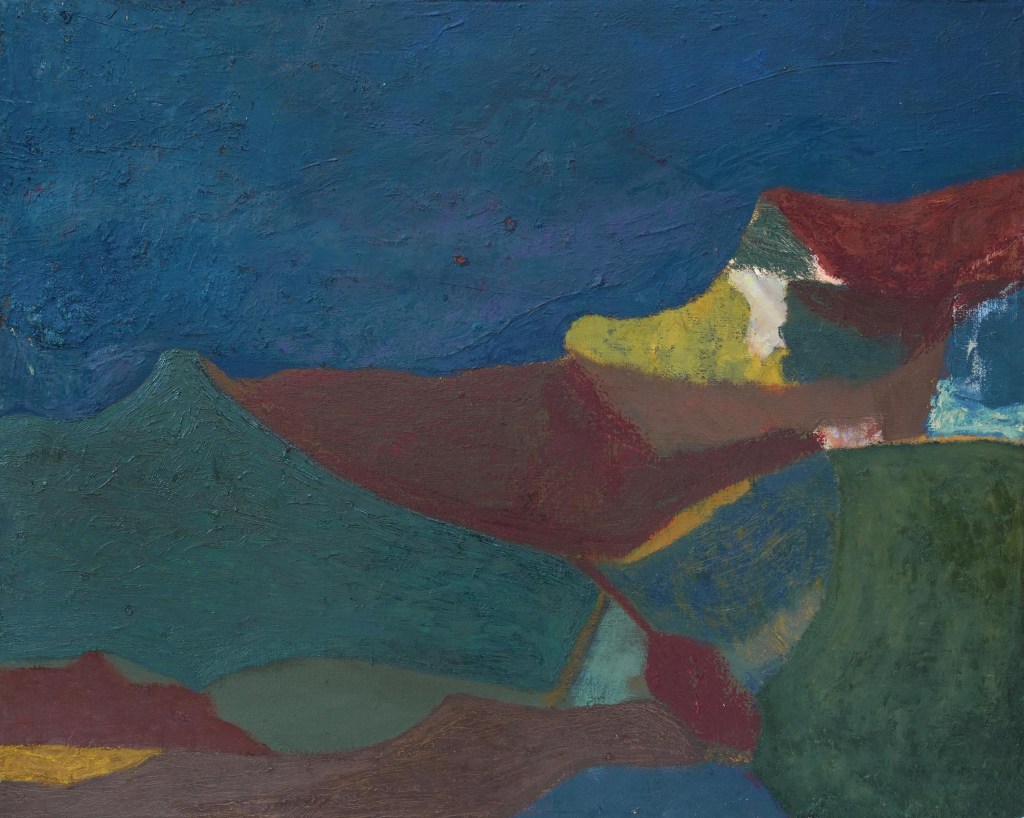
Drawing inspiration from time sitting in contemplation looking out at beautiful landscapes, Nick Gorham takes these sensorial memories and paints them onto canvas. They are not of any particular place, but a collection of deep feelings and memories from being within the mountains, forest, fields, and sea.
Cliff, is one such rendering of Gorham’s abstractions of nature. It becomes familiar to anyone who finds home and unity with nature. The shadows on the rolling hills by the cliffs that drop into the sea or valley, cast at dusk, after the sun sets and before the first stars become visible.
Nick Gorham is a California-based artist who focuses on landscape and abstract painting. He received his BFA in painting from Pratt Institute in 2023. His work has been exhibited at Marin MOCA, Et. Al. Gallery, Chandler Gallery, and Park Life Gallery.
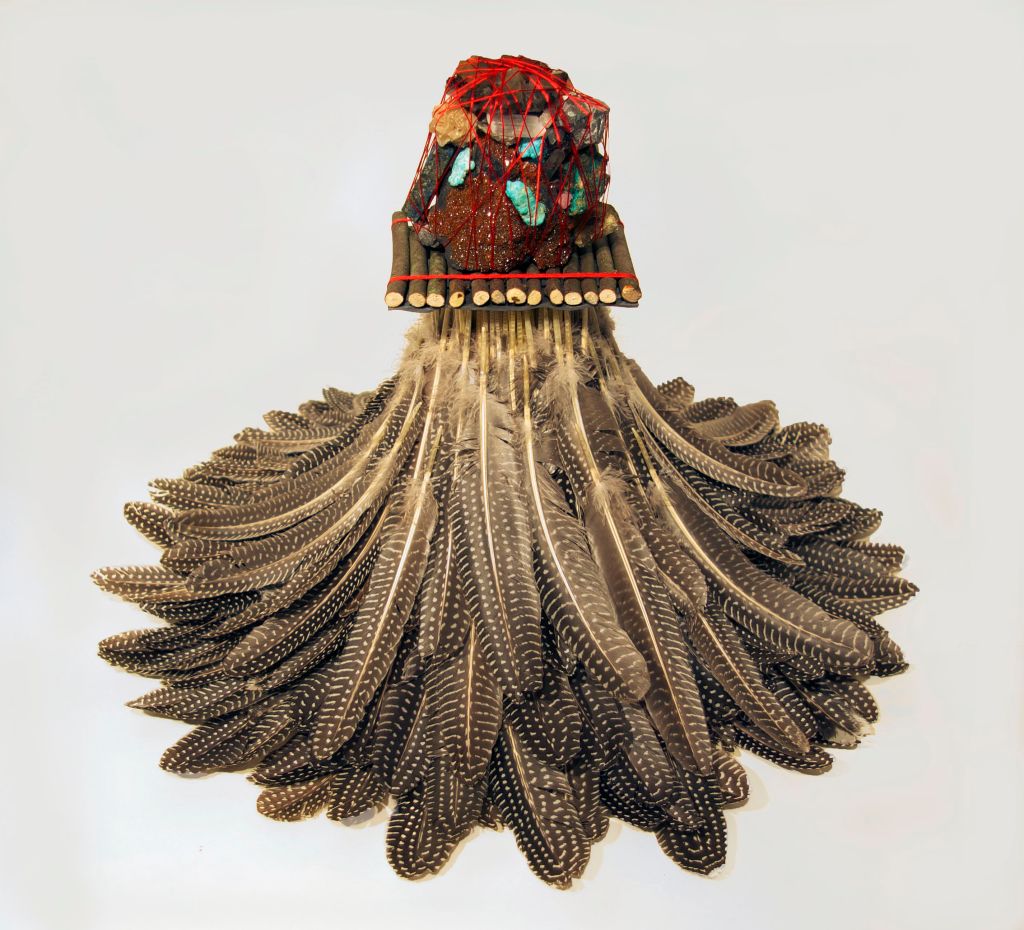
Raft by Shea Hembrey is a lyrical, representation of our planet, this earth, adrift on a raft in the vast, wonderous, and mysterious cosmic universe. Hembrey grew up wild, he ran free, and with his imagination both wild and free. From his rural Arkansas upbringing he pondered the world beyond, into the expanse of the cosmos, beyond the Big Bang, and toward the mysteries of dark matter.
Hembrey is a most multi-talented artist. In 2011, he debuted SEEK 100, which he described as “a new international biennial”. In an extraordinary feat of imagination and creative invention, Hembrey conceived and brought together an entire biennial comprising 100 artists. He 100% created each artist’s biological narrative and the varied artworks crafted from a wide range of mediums. The entire creative genius was the work of one artist—Shea Hembrey. As he explained his artistic philosphy, “I believe in soul-filled art with masterful craftsmanship and intellectual rigor. I focus on exploring big question and speaking to a broad audience while playfully transcending myself and identity.”
With Raft Hembrey invites the viewer to contemplate the bigger questions of our existence: What is the natural world, and how do we coexist and understand our interconnectedness within it? How many galaxies and universes are out there? His curiosity extends beyond the known universe and toward the possibility of a multiverse. Yet, amid these immense cosmic questions, Raft, brings us back to quiet wonderment of life on earth.
Grounding his expansive vision he sources from the beauty of our planet, Hembrey incorporates materials drawn from the earth: minerals, rocks, twigs, and bird feathers gathered during his exploration of nature. Raft reminds us that the extraordinary is all around, in the vastness of the universe and beneath our feet.
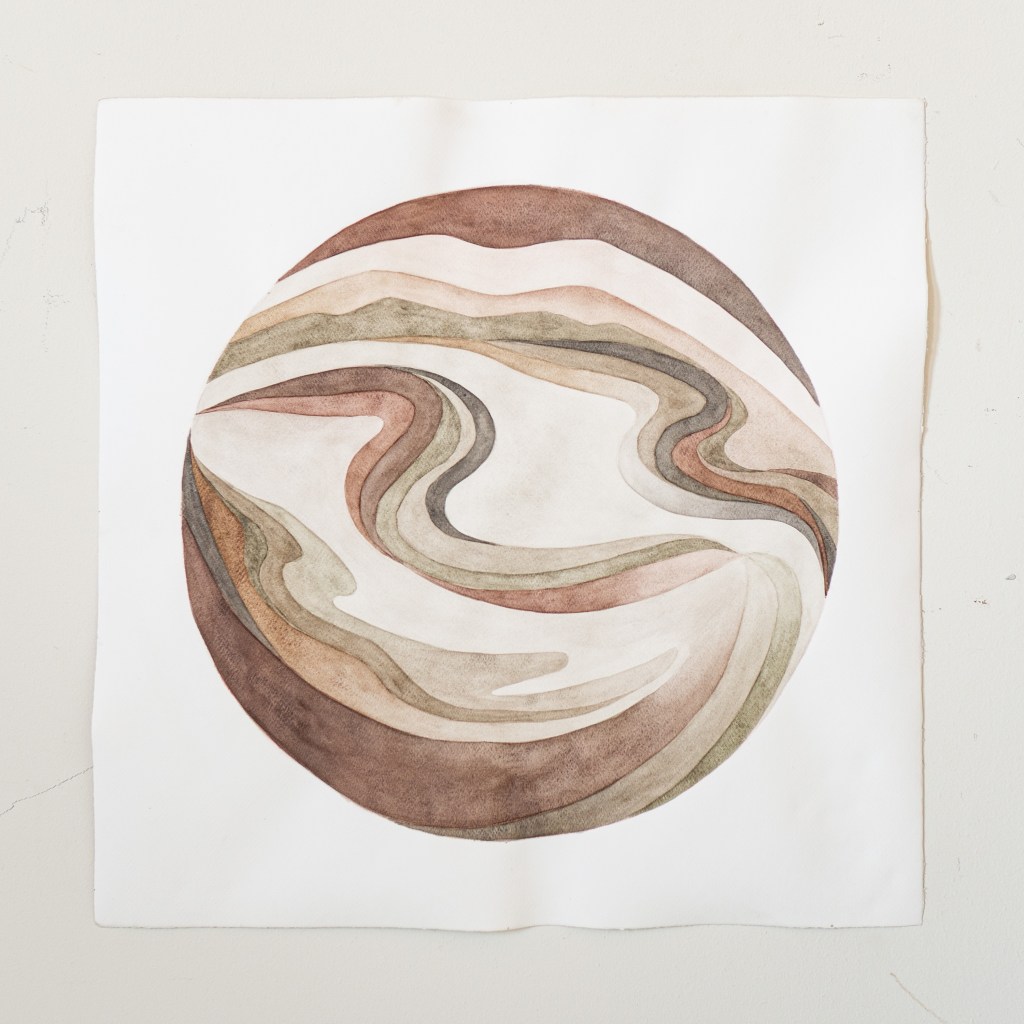
Julie Kim is a Seattle based, Korean-American artist. She studied traditional oil painting, receiving a BFA at University of Washington, yet freed herself to flow with her own expressiveness in using watercolors made directly from earth. In fact, she is responding back to an even older tradition of art making. The history of art made from rocks and mineral pigments spans over 100,000 years, beginning with prehistoric humans grinding earth and stone into powder.
Using the earth as both muse and material, Kim creates flowing paintings from rocks and minerals she gathers on her meanderings in the Washington state mountains. She grinds them down, mixing them with honey, clove oil, gum Arabic, and a watercolor binder.
Each of her works are more than paintings, they are in essence a dialogue, a connection with the land—infused with each painting is a sense of place, time, and natural elements.
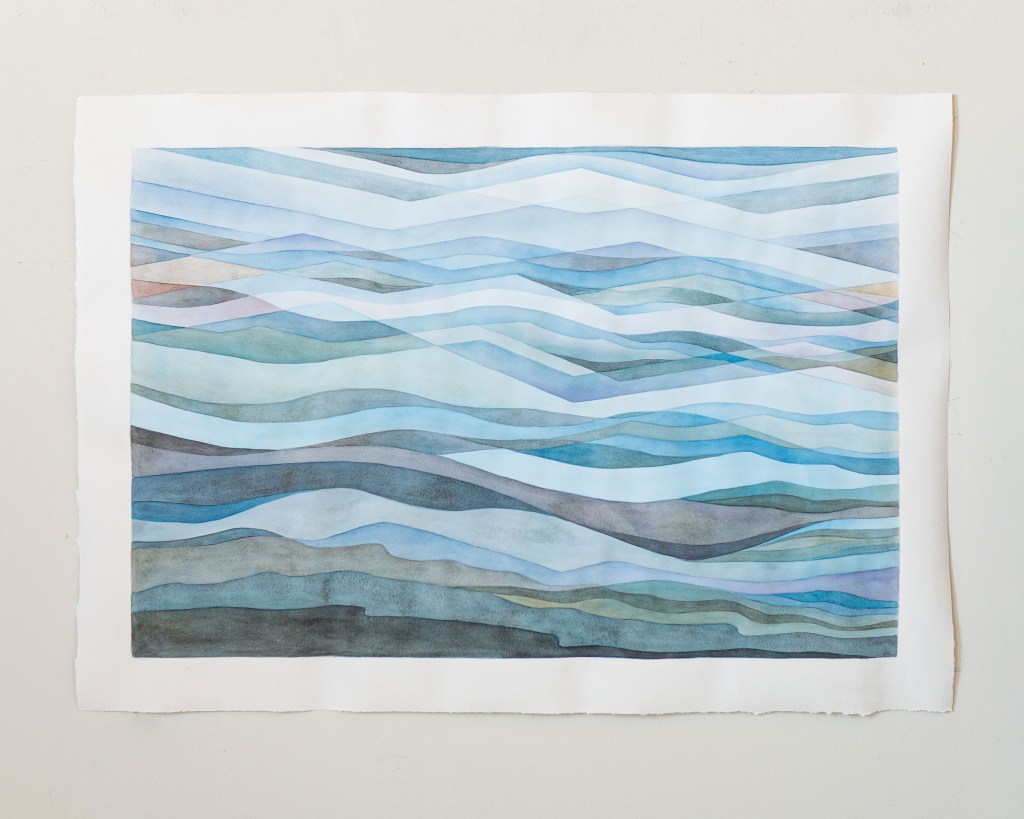
Landing swirls on the paper like sediment flowing downriver, and reflects weathered patterns found on seaside rocks, shaped by the currents of water and time. Mountains Like Water, illuminates a keen perception in vision, a mirage, when the mountains in the distance meet with the sky. Light rays from the sky dance and flow through different currents of air, making land look like water and merging the two, sky and land, as one, united and continuous. More than an illusion, it’s a visual dream or shimmering hope of unity and interconnected life.
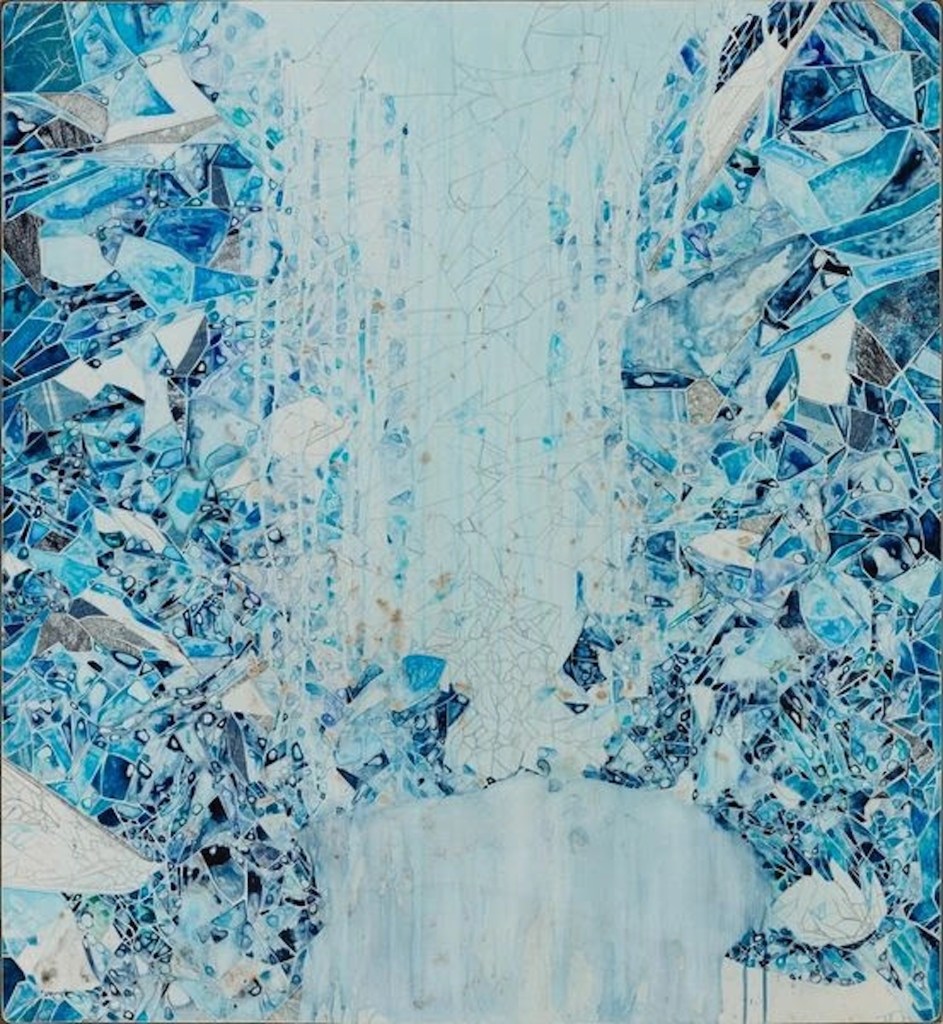
Education/knowledge—refinement, learning, social improvement, enlightenment, acquirements—which of these resonates with our understanding and memory of our relationship with, and manipulation of, nature? This question comes to mind in Erica Mahinay’s painting, Nocturne. And what do we see? Is the darkness serene, or disturbing? Is it a nocturnal landscape or an otherworldly moonscape? Is it an eerie starless and moonless sky or a moon just beyond, out of view, its light reflected on the soft mountain peaks? Could the shimmerings of gold and silver be signs of a luminous, mineral rich earth, or do the seams represent a scarred earth? Can education answer these questions or are the answers imprinted through experience—through an ecopsychology?
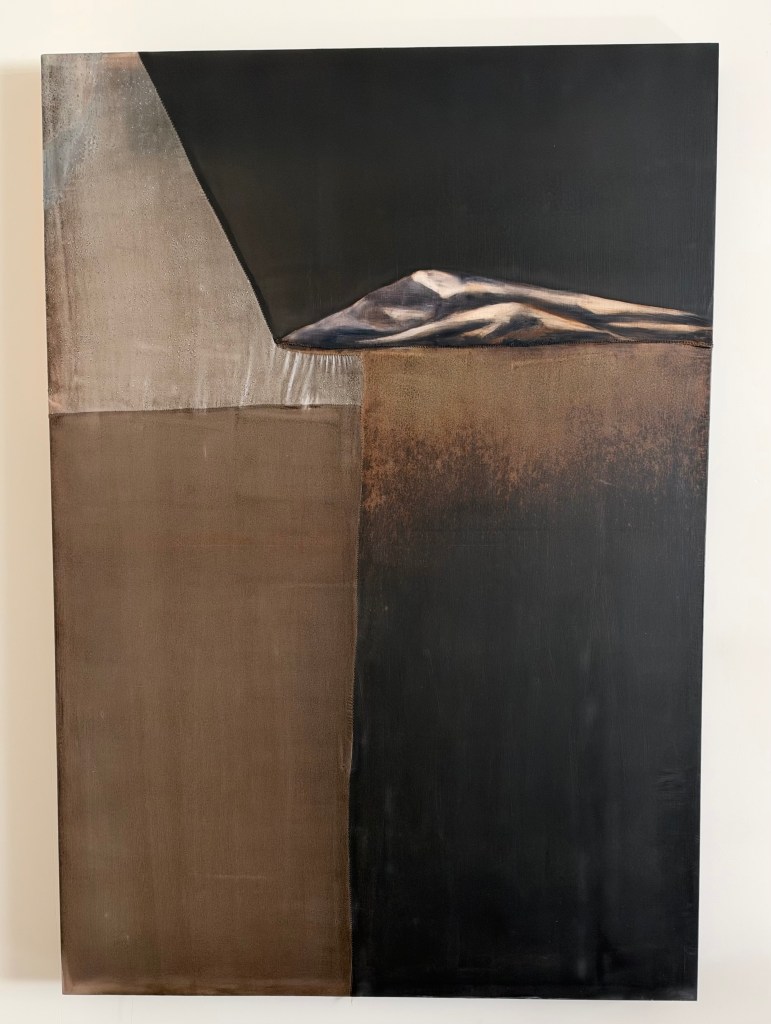
Ecopsychology is an interdisciplinary field that explores the connection between the human mind and the natural world. It’s core philosophy, rooted in traditional indigenous perspectives, recognizes our interconnectedness with nature. It suggests that the human mind evolved within natural environments, and that our modern alienation from nature may contribute to psychological distress. The natural environment in which we are raised leaves its imprint on us, shaping our inner landscapes through an embodied, synergistic relationship. It proposes that healing one’s mental health is intertwined with healing the planet; the two are inseparable.
Mahinay’s art practice draws upon intuition and an embodied sense of making. Through layering, revision, and responsiveness, she blurs the boundaries between gesture and action. Allowing the painting to emerge through an evolving dialogue between artist, psyche, and material. Speaking about her process, Mahinay describes, “allowing meaning to remain fluid and indeterminate…each painting hovers between clarity and dissolution…” In this process her gestures and applications reveal something of her own ecopsychology—an intimate, lived relationship with the natural world. Through observation, each viewer brings a different history, memory, and sensibility to the work. What emerges is not a concise answer, a singular interpretation, but a personal resonance between the seen and felt. The unknown becomes uniquely known to the individual.
Erica Mahinay grew up in Santa Fe, NM. She received a BA from Kansas City Art Institute in 2008 and an MFA from Cranbrook Academy of Art in 2013. Mahinay has had solo exhibitions at Lyles & King, New York (2019, 2017); T293, Rome (2019, 2014); Ibid Gallery, Los Angeles (2016); Jessica Silverman, San Francisco (2015); and Loudhailer, Los Angeles (2014). Recent group exhibitions include those at Lyles & King, New York (2019, 2018); Jir Sandel, Los Angeles (2017); Rainbow in Spanish, Los Angeles (2016); Anat Ebgi, Los Angeles (2016); Artist Curated Projects, Los Angeles (2016); and Embassy, Los Angeles (2016). She was an artist-in-residence at the Vermont Studio Center (2009–10). She is a current resident at Headlands Center for the Arts (2026).
Jonah Reenders’s impeccable photographic eye captures the complex relationship between humanity and the natural world. Humans are part of nature, yet we often perceive nature as something separate from ourselves. Reenders is interested in this question of separation, “I find myself coming back to this idea…, the ways we position ourselves as outside of these systems rather than within them.” Looking at both perspectives, his photographs reveal how humans impact and shape nature.
Reenders’s perspective is rooted in scientific observation. After graduating with a BS in Environmental Science, he spent almost a decade working as a field biologist, studying endangered species, shrinking habitats, and dying landscapes. He worked as research assistant on a leatherback sea turtle and primate studies on the remote island of Bioko, off the west coast of Africa. There, he lived in a tent for seven months without electricity or connection to the outside world, spending lengths of time alone, in stillness, sitting in trees, watching birds, and hiking through thick jungle terrain. The experience taught him how to pay close attention and to truly look.
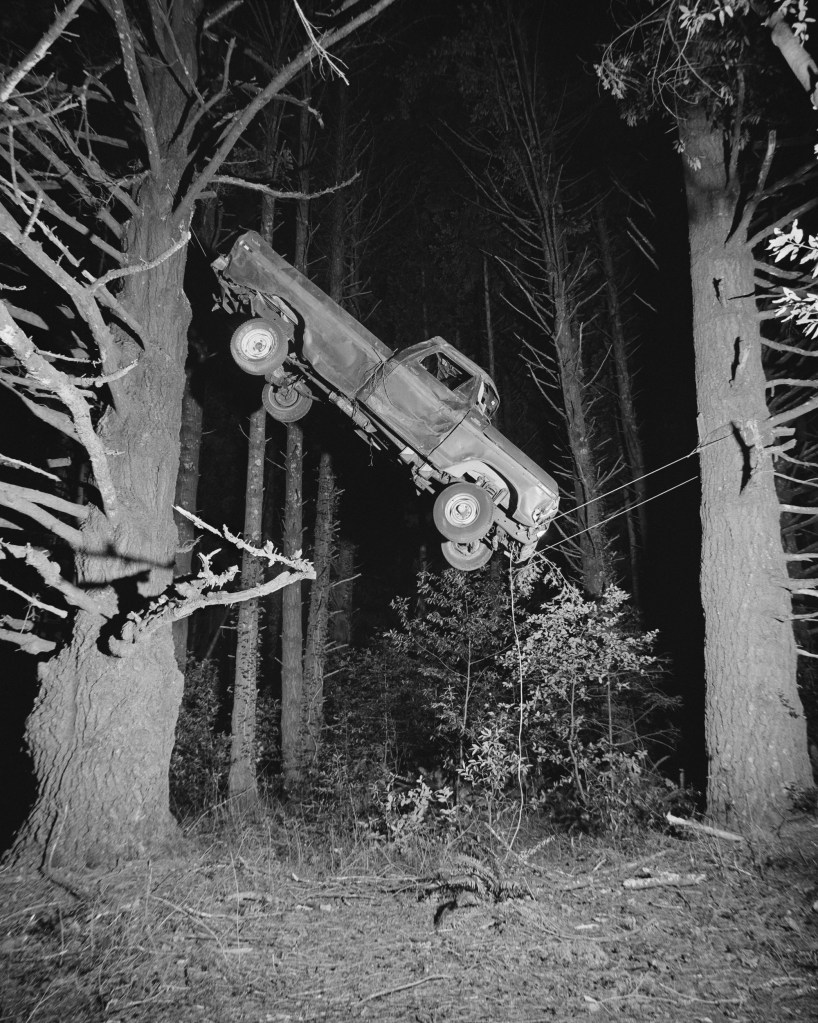
Even though grounded in scientific observation, there is a sense of humor, as well as a bit of the unusual. In his art. Untitled (Truck in Tree), suspended in the trees like a hammock, makes you wonder and chuckle at the same time. Deep in the remoteness in Humboldt County, surrounded by remarkable towering redwoods, encountering the uncommon and sometimes bizarre human-made creations becomes a part of this unique ‘wilderness’. One can almost imagine a wise owl taking up residence in that truck.
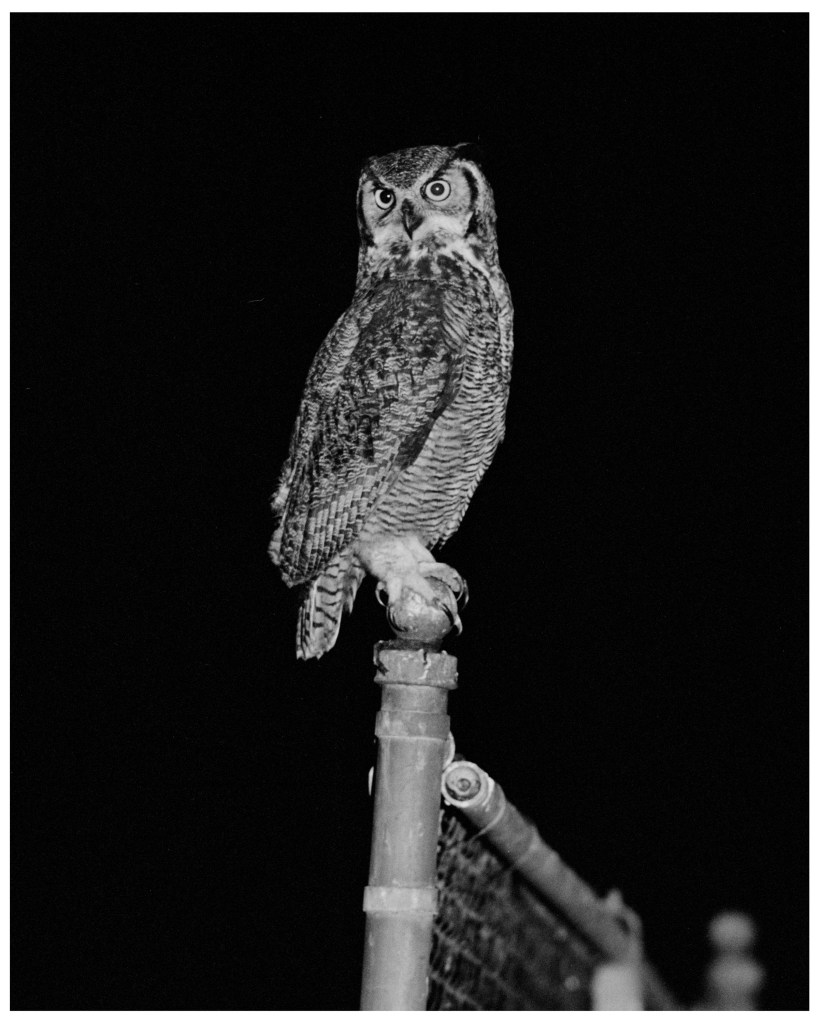
Great Horned Owl, Headlands, perched on another human-made structure, indeed sits a magnificent wise owl. Reenders captures that moment between observing and being observed. The photograph becomes a keen-eyed perspective on the relationship between humans and nature. The owl hunts in proximity to humans, whose pantries and garbage provide an abundance of prey—rodents. Its piercing gaze suggests that its more annoyed than threatened.
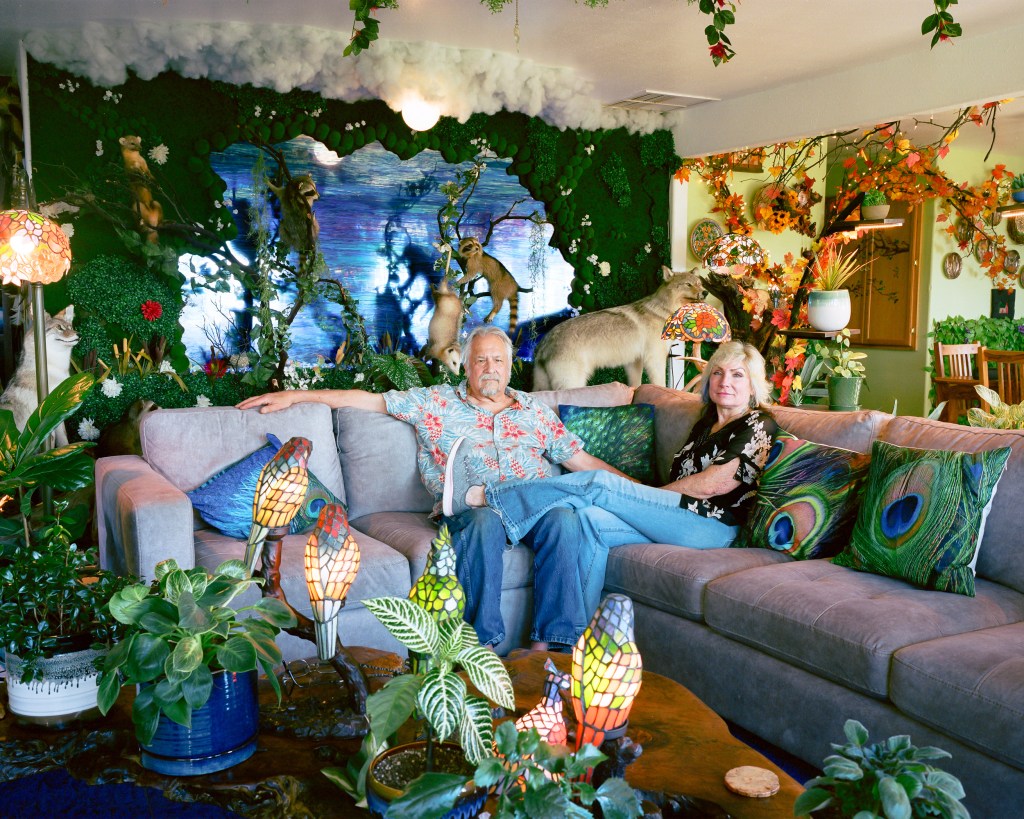
John and Chayenne, Clear Lake offers another offbeat interpretation of what it means to live with nature—or at least within their unique and fantastical version of it, where natural history museum, kitschyness, and home converge. Here, Reenders work reveals his inspiration from Hieronymus Bosch’s painterly surrealism and use of symbolism to interpret and question the natural world.
Reenders’s photography is perhaps more Diane Arbus than Ansel Adams: less concerned with idealizing nature than with revealing its incongruencies, peculiarities, contradictions, and entanglements with human life.
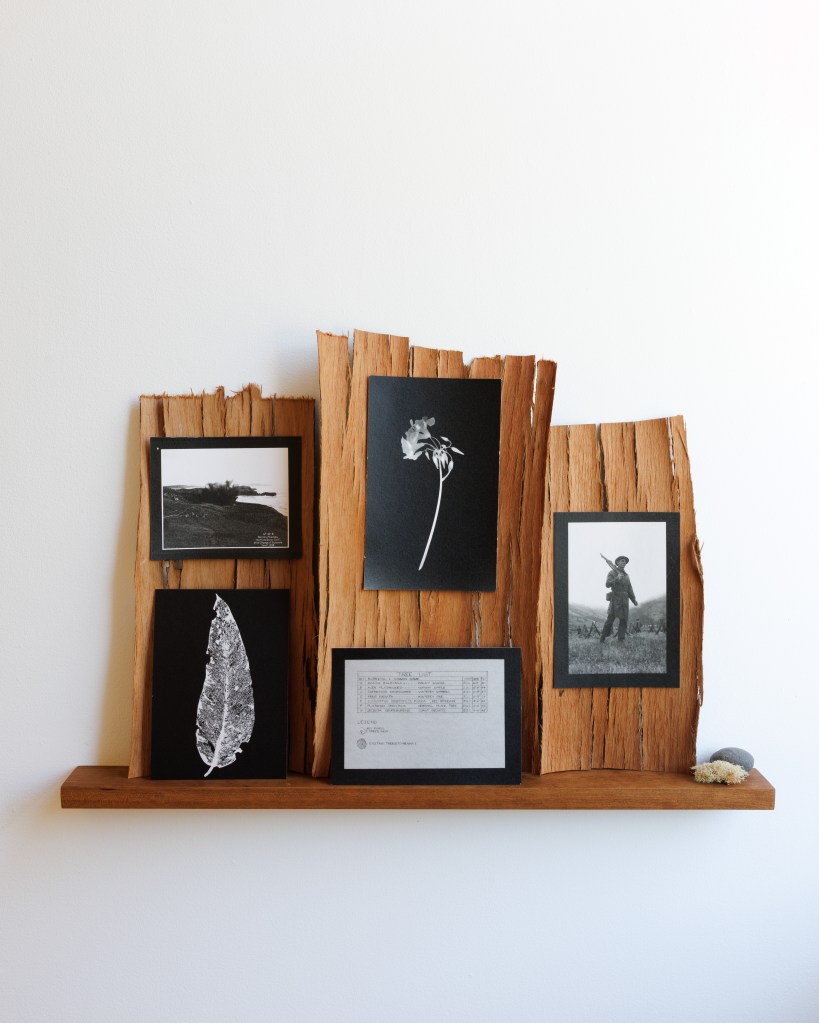
During his residency at Headlands Center for the Arts, Reenders created an ensemble of found eucalyptus bark, images of plants observed on his walks, and historical records from period when the Golden Gate Recreation Area was used as a military base. The Trees have Ears and the Field Has Eyes, chronicles this particular time and place. His investigative curiosity began with the simple act of noticing trees in the landscape. Drawing on his background in scientific research, lead him down a path to find their identity and origins, gather historical data, and eventually discovering that they had been planted during the Army’s occupation at the Headlands as a method for camouflage.
He wove together these discoveries into a layered narrative that seeks to understand ecological connections between both human and natural histories, and ways in which the landscape has been shaped by both. These interactions deepen his curiosity about what is native and non-native, while pushing him to question the viabilities of human-centered ideologies that continue to shape the natural world.
Jonah Reenders received his MFA from California College of the arts in 2025, after which he was awarded a year-long graduate fellowship at Headlands Center of the Arts. His work has been exhibited in Teleport Galerie in Prague and the Institute of Contemporary Art, San Francisco.
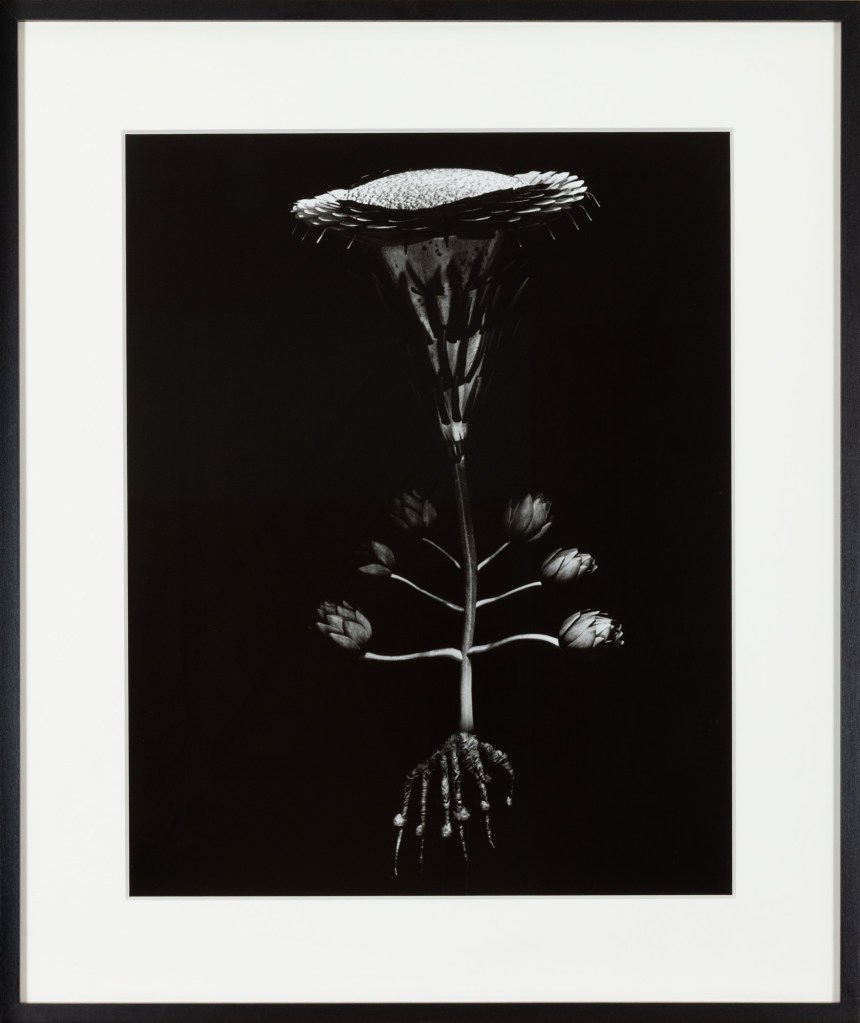
The Voynich Manuscripts may be one of life’s big mysteries. They have been researched, analyzed, debated, and have stumped scholars, cryptographers, physicists, and computer scientists. Are they a prank or are they a significant text from the late 15th century? The manuscripts were named after Wilfrid Voynich, a Polish dealer who purchased them in 1912. George Baresch, an alchemist from Prague, is the earliest known owner of these manuscripts containing roughly 240-pages of medieval codex written in an indecipherable text or code, filled with bizarre drawings of esoteric plants, naked women, and astrological symbols.
Miltjohn Ruperto, based in Los Angeles and Ulrik Heltoft, from Copenhagen, inspired by the ink and colored botanical illustrations in the Voynich Manuscripts, collaborated to create a series of twenty photographs titled, the “Voynich Botanical Studies”. Using computer imaging software, Ruperto constructs three-dimensional visualizations of individual plants, each unidentifiable and strangely mysterious. Heltoft then transforms each digital file into a negative, from which he manually produces silver gelatin prints in a dark room, using traditional photographic techniques. This digital and analog process suspends these art works into the realm of reality and unreality, building upon the uncertainty and mystery. Much of what we face today with deepfakes, computer and AI generated images, leaves us in a haze of questioning what is real.
Miltjohn Ruperto was born in the Philippines lives and works in Los Angeles. He received his BA from University of California, Berkeley and MFA from Yale University. Ruperto has exhibited his work internationally at numerous institutions, including: REDCAT Gallery, LA, Kadist, San Francisco, ILHAM gallery, Kuala Lumur; Para-Site, Hong Kong; Haus der Kulturen der Welt, Berlin; Magazin4 Bregenzer Kunstverein, Austria; Whitney Museum of American Art, New York; Cantor Arts Center, Palo Alto, California, and others.
Ulrik Heltoft born in Denmark and lives in Copenhagen, received his MFA in sculpture from Yale University and studies at the Royal academy of Fine Arts in Copenhagen. His work has been the subject of solo exhibitions at Secession, Vienna; Aarhaus Center for Contemporary art, Denmark; Raucci Santamaria, Naples; Willfried Lentz Gallery, Rotterdam; and numerous notable group exhibitions.
Beatrice Victoria Thornton is a Northern California native and an Oakland-based archivist, design historian, and environmental land artist whose primary medium is black-and-white film photography. She grew up in Mill Valley, CA and spent thirteen years in New York after moving there to attend New York University. Since returning to the Bay Area in 2018, she has begun building an art practice centered around analog photography.
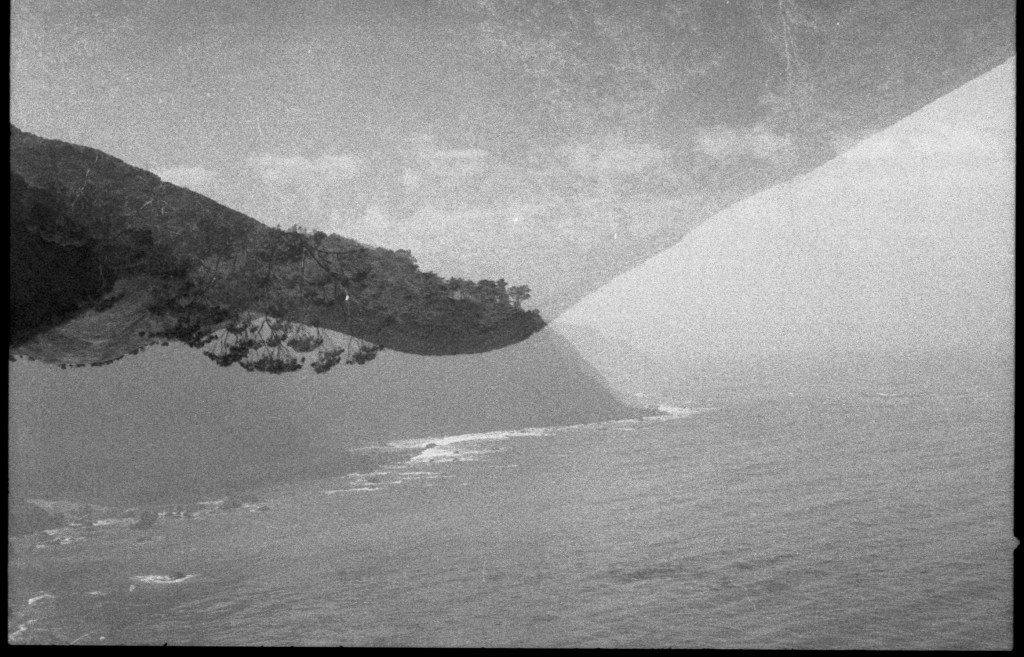
Thornton uses sustainable darkroom processes, by crafting a homemade chemistry of ingredients that includes foraged plants rather than traditional darkroom chemicals. Through this process, she produces plant-developed gelatin silver prints—photographs in which nature becomes part of the making.
Thornton finds inspiration for her art roaming the trails around northern California, with her deep attentiveness to the natural landscape. Floating Pacific Santa Lucia was made from a walk along the trails above the Monterey County coastline. There she gathered fig leaves and yarrow, bringing them back to the darkroom, where with a kind of alchemic magic, they became part of the chemistry to develop this silver gelatin print.
Sunlight contains every color of the spectrum mixed together, yet in the intensity of midday sunshine, our eyes see pure white. Rising from the Pacific, a glistening haze of white heat obscures clear vision. The view dissolves into light. We imagine just beyond the bend in the trail, a tree’s shadow—shade. It’s a timeless vision. At once, physical and dreamlike. Looking at Floating Pacific Santa Lucia the lyrics of the The Doobie Brothers seem to rise instinctively to the surface, “Horizon of blue, hills are rollin’/ Walkin with you through a field of red stones/ I been confused from voices callin’/ Callin’ to me where the white sun has shown.”
The photograph holds that same suspended moment—between land, sea, sky, and light, where what we see and what our memories imagine begin to merge.
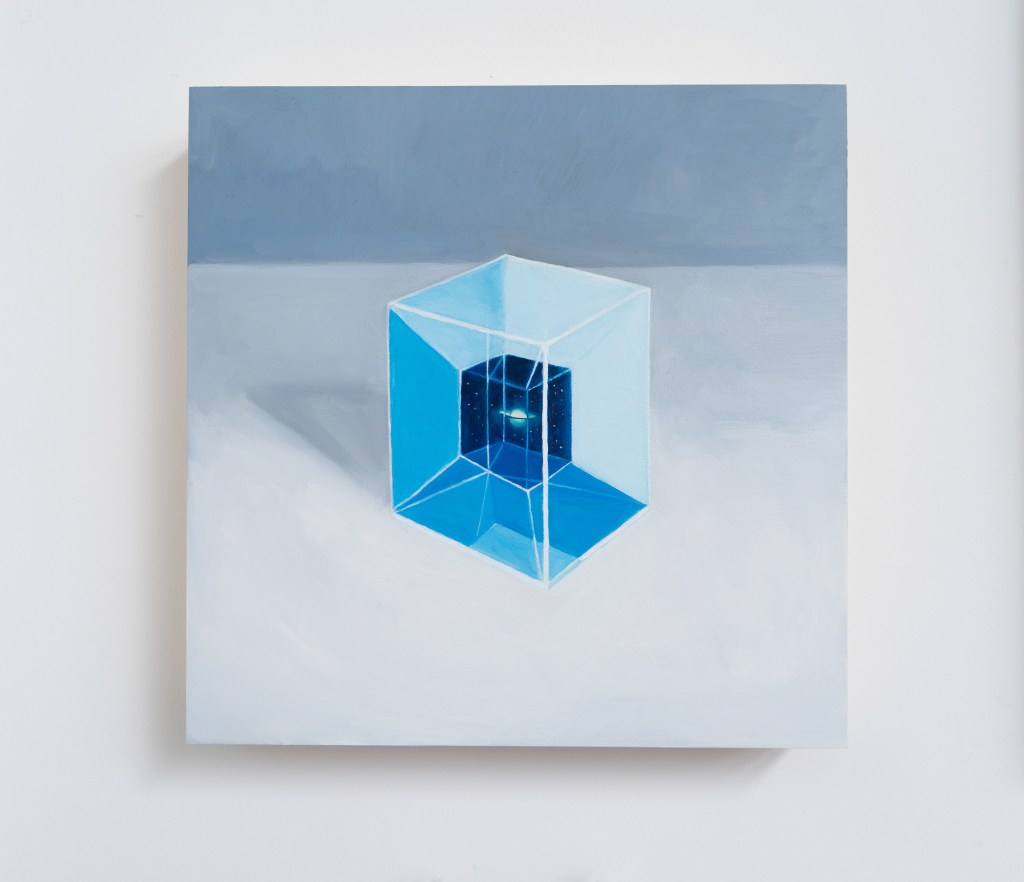
Ruxue Zhang considers the relationship between human perspective, space, and our experience of reality. She explores this through use of a tesseract, a four-dimensional hypercube, a plot device used in writing science fiction, it is an alternative perception. Tesseract 5 is a part of her Tesseract series that explores the questions: what is reality, and what is beyond human perception of known dimensional space; what is natural, how do we make sense of our world and how can we exist in a multiverse?
In this small painting, Saturn is contained, evoking a preciousness, as a treasure we must protect. Do we try to contain/protect our world, do we put ourselves in a box? Zhang contemplates this notion, “I read a book called Cosmos by Carl Sagan. In the book, there is a 4D tesseract model. Scientists use it to show people how we can travel through time and space. But time is just an illusion. The way we understand the world is 3D. The tesseract is 4D. To me this feels like the fundamental limitation of the human brain: we understand the cube but we cannot understand the tesseract. So we keep things simple, and we enjoy the limitation. We put everything we know in a box: Our house is a big box. Our car is a box. Our smartphone is a small box. Ultimately, we put ourselves in a box in the ground. Humans are happy to constrain ourselves so we are not overwhelmed”
The Earth is interconnected with the Universe, itself part of a vast and mysterious Multiverse. Reflecting on her art, Zhang contemplates, “As Multiverse theory claims “the universe does not have a single existence or history, but rather every possible version exists simultaneously.” might I exist in multiple realities?” Tesseract 5 unearths questions about the future of nature. As molecular biology reveals the intricacies of DNA, technological interventions reshape the living world, and scientific advances expand our exploration and observation of space, what might a future natural world become and look like? Will it change our perception on what is considered natural and artificial? What gets lost and what is gained?
Ruxue Zhang was born in Wenzhou, a river city in the south of China, in 1992. She graduated from Central Academy of Fine arts in Beijing (BFA 2015), and California College of the Arts (MFA 1018). Her work has been exhibited at CULT/Aimee Friberg Exhibitions, Root Division, Cal State University in Los Angeles, and the CAFA Museum in Beijing, to mention a few.
If ever there was an artist who radiates good vibes, it’s Dave Muller. Over the decades his installations and exhibitions bring his audience into an immersion of good times. With a turntable spinning vinyl, and human-scale paintings paying homage to albums from musical icons, such as—The Beach Boys, Abba, Kraftwork, Funkadelic, Journey, Johnny Cash, Bowie—and colorful mirrored disco balls, Muller transports us to the party, onto the dance floor, where music brings us together. Early in his career he held three-day weekend social art events, which were in part pop-up art exhibitions for his art-school peers, and a place for artists to gather, listen to music, to have a good time.
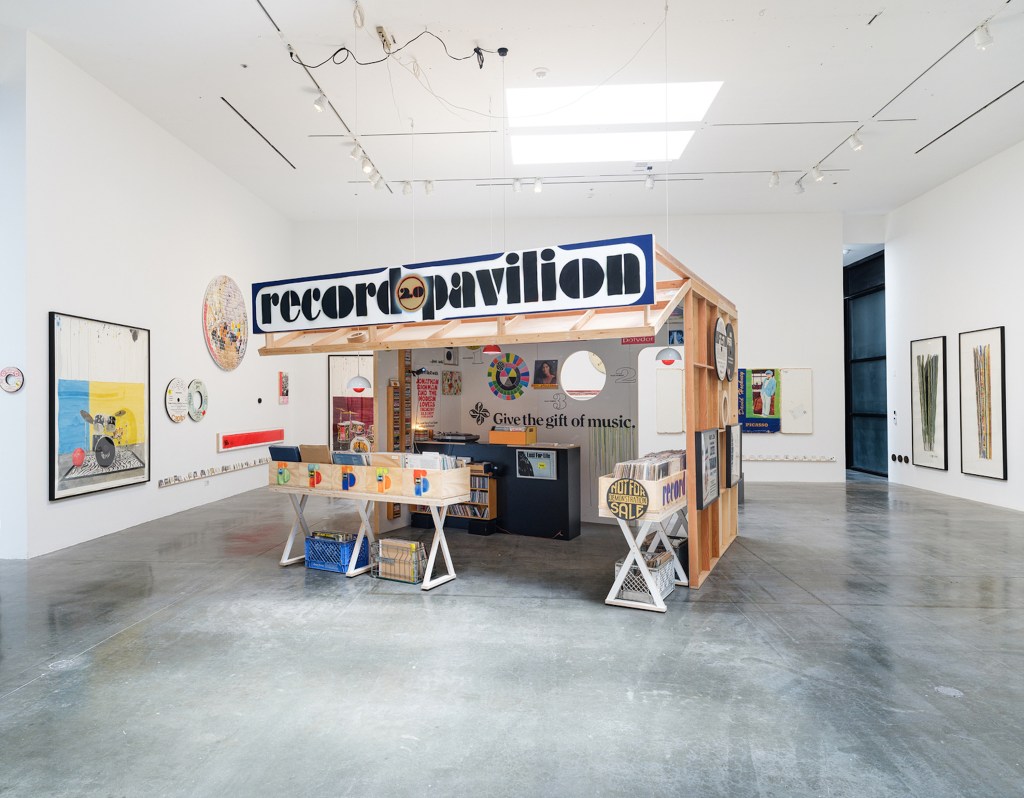
What does this have to do with the climate crisis, with nature, or with our earth, you might ask?
Look up. Blue skies fill the background of many of Muller’s paintings and murals. Lesser known are his series of Sprawling paintings, where the focus is on the blue sky—mostly, quintessential California blue skies—brushed with thin whiffs of drifting clouds; others include fragments of familiar landmarks. Many offer nothing more than open expanse of soft blue sky. And yet, in that simplicity, we are uplifted.
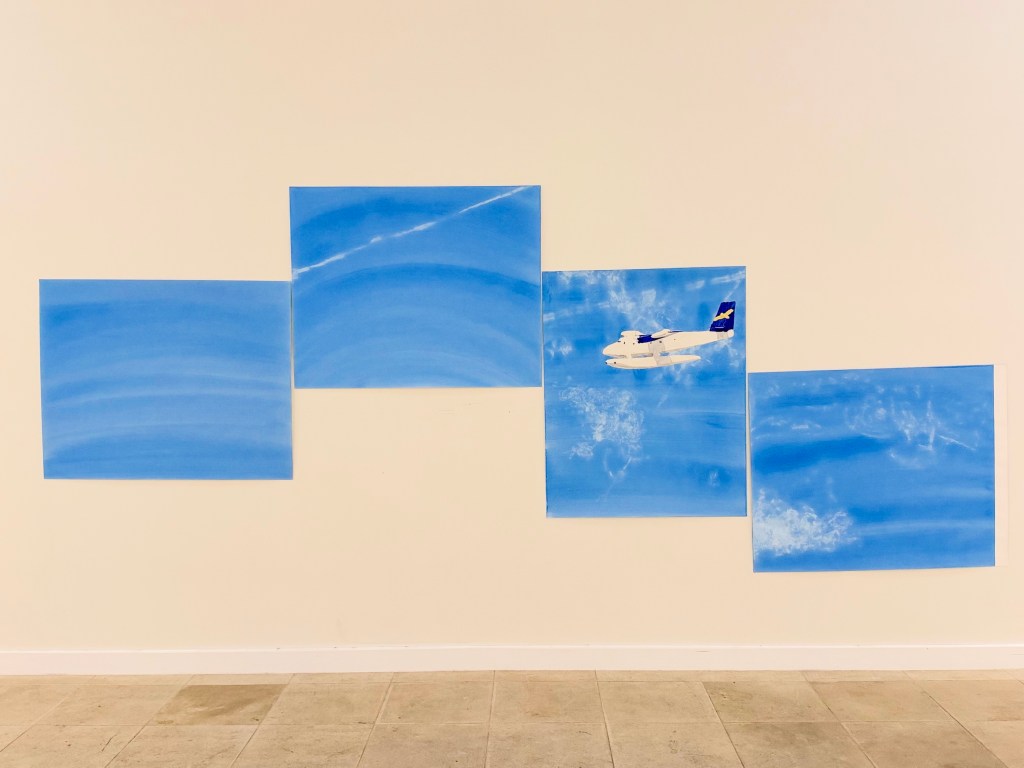
Can’t you hear it? Electric Light Orchestra’s Mr. Blue Sky, the Allman Brothers Band’s Blue Sky, or the many singers that have sung of Blue Skies—Ella Fitzgerald, Willie Nelson, Tom Waits, Frank Sinatra. So many sang about the uplifting feeling of blues skies. Muller’s paintings carry that same tune of inspired lightness.
Thank you, Dave Muller, for reminding us of the good feeling that blue skies can bring.
This is where Muller’s art finds its place in this essay and exhibition of art and the Earth. Blue skies are a familiar global recognition of clean air and a powerful symbol of a positive, optimistic future we can see, metaphorically and figuratively.
The protection of the whales, the fight for clean air and water have all experienced setbacks and breakthroughs. The dangers of air pollution were recognized as early as antiquity, since the time of Hippocrates, then industrialization and urban growth intensified the problem, filling cities with smoke and toxic emissions. The Great Smog of London of 1952 and the growing crisis of acid rain in the 1960s brought air pollution into sharp focus and urgency. This awareness galvanized public outcry, which brought about regulations with the founding of the U.S, Environmental Protection Agency and the Clean Air Act, both in 1970.
These achievements matter. They demonstrate that people can demand change. But progress is not linear. We mustn’t take past progress for granted. Today we can acknowledge progress, for example, LA hasn’t had an official “smog alert” day since 2003, yet we can’t let up, or reverse progress. While many U.S. cities have substantially improved air quality, climate change and pollution continue to pose a threat to our ecological health. We now realize it’s a global challenge, carbon dioxide emissions have increased in developing economies, as we shift focus on India and China. We can celebrate improvements while at the same time support stronger enforcements, because as past problems found solutions and new problems need us to find the solutions.
The hardest part of creating change is sometimes believing we can, that change is possible at all. Inundated with relentless headlines of environmental destruction and political division, it’s easy to lose heart. Optimism is not a denial of reality; it’s a decision to keep moving forward. It gives us hope, trust, solidarity, energy to act—and the absolute belief/conviction that we can come together for the benefit of this planet and all life.
Perhaps a blues sky is more than a beautiful backdrop for a painting or the inspiration for a favorite song. Perhaps it is a dose of positive vibes, not that change is easy, but that a better future we imagine is possible. Art can help us imagine that future.
Please email meadowkat1@gmail.com to receive information for the prices and online auction site, opening for bidding on November 4, 2026
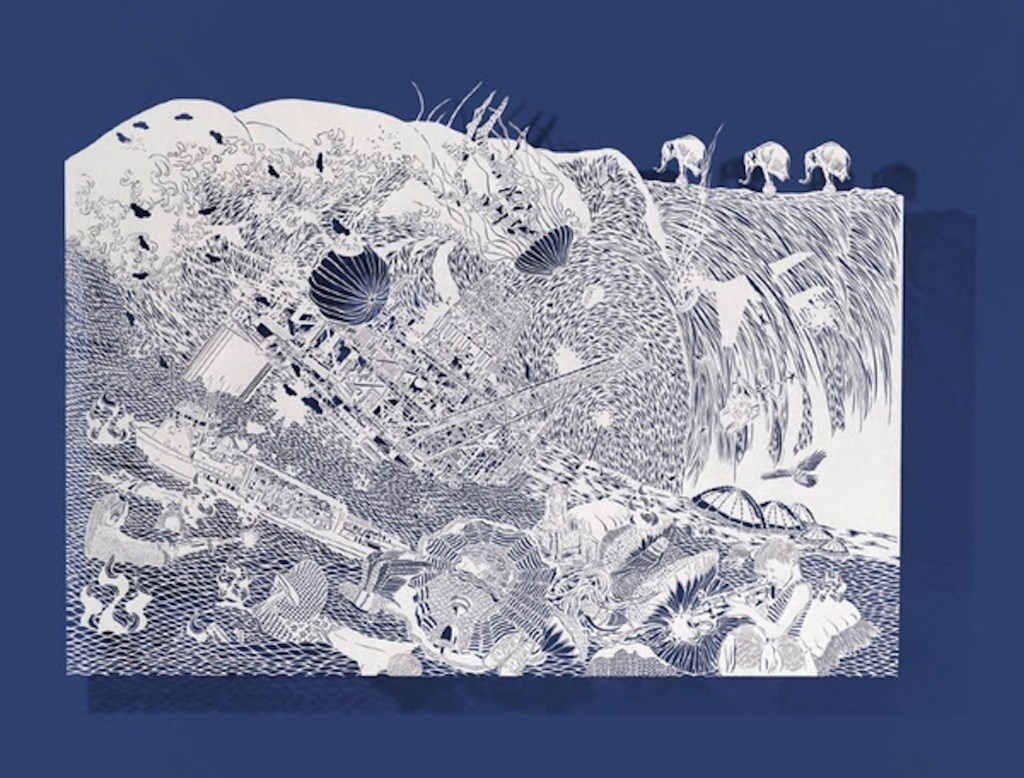
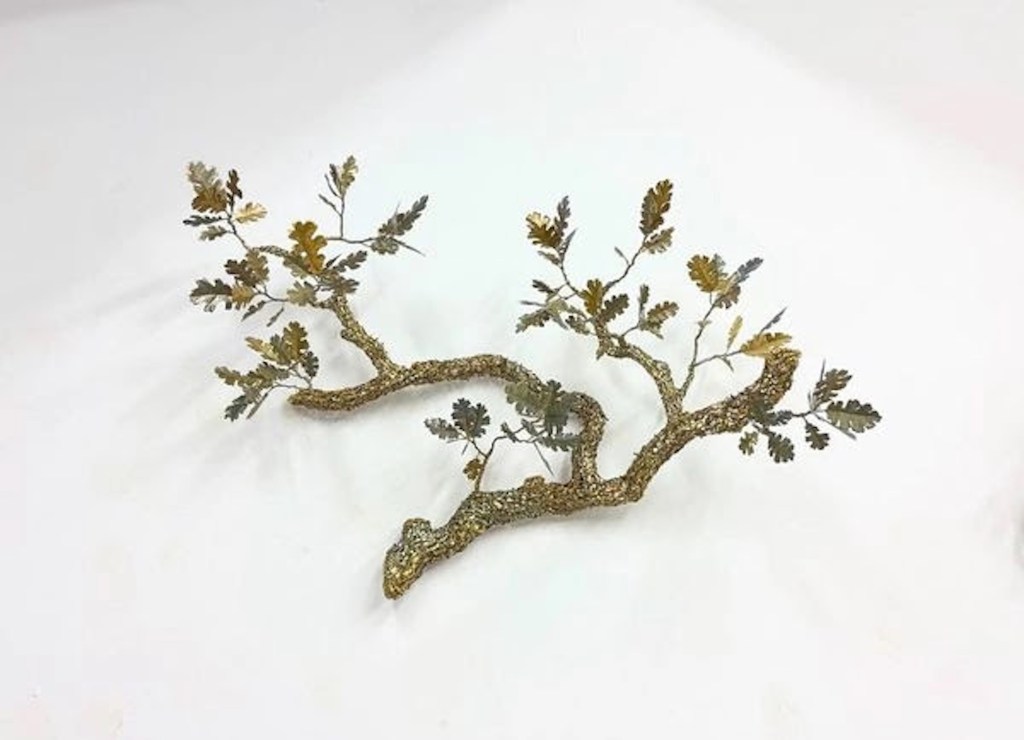
Included in the exhibition are works by Maybuam Gallery artists: Belinda Fox, Rebecca Johnson, Bovey Lee, Kirk Maxson, Victoria Wagner.